
Ch.13 Alkenes, Alkynes, and Aromatic Compounds
McMurry - Fundamentals of General, Organic, and Biological Chemistry 8th Edition
McMurry8th EditionFundamentals of General, Organic, and Biological ChemistryISBN: 9780134015187당신이 사용하는 게 아니라요?교과서 변경
13장, 문제 82

Why do you suppose small-ring cycloalkenes like cyclohexene do not exist as cis–trans isomers, whereas large ring cycloalkenes like cyclodecene do show isomerism?

검증된 단계별 안내
1
Understand the concept of cis-trans isomerism: Cis-trans isomerism occurs in alkenes when there is restricted rotation around the double bond and two different groups are attached to each carbon of the double bond. The spatial arrangement of these groups determines whether the isomer is 'cis' (same side) or 'trans' (opposite sides).
Examine the structure of small-ring cycloalkenes like cyclohexene: In small-ring cycloalkenes, the ring size imposes significant geometric constraints. The double bond in cyclohexene is part of a six-membered ring, and the ring's rigidity forces the substituents on the double-bonded carbons to be on the same side of the ring. This makes the 'trans' configuration impossible due to severe ring strain.
Compare with large-ring cycloalkenes like cyclodecene: In larger rings, such as cyclodecene (10-membered ring), the ring is more flexible and can accommodate both 'cis' and 'trans' configurations without introducing excessive strain. This flexibility allows for the existence of cis-trans isomerism in large-ring cycloalkenes.
Relate to ring strain: Small rings experience significant ring strain due to bond angle deviations from the ideal tetrahedral angle (109.5°). Introducing a 'trans' configuration in a small ring would further increase this strain, making it energetically unfavorable. Larger rings, however, have bond angles closer to the ideal and can adopt conformations that reduce strain, allowing for both isomers.
Conclude the reasoning: Small-ring cycloalkenes like cyclohexene cannot exhibit cis-trans isomerism because the ring's rigidity and strain prevent the formation of a stable 'trans' isomer. In contrast, large-ring cycloalkenes like cyclodecene are flexible enough to adopt both 'cis' and 'trans' configurations, enabling isomerism.

비슷한 문제에 대한 검증된 영상 답변:

이 영상 해법은 위 문제에 도움이 된다고 튜터들이 추천한 것입니다.
도움이 되었나요?

주요 개념

질문에 올바르게 답하기 위해 반드시 이해해야 하는 핵심 개념들은 다음과 같습니다.

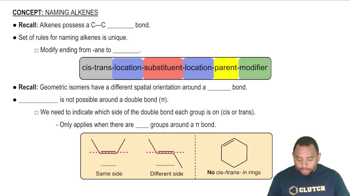
Cis-Trans Isomerism

Cis-trans isomerism, also known as geometric isomerism, occurs in compounds with restricted rotation around a bond, typically a double bond or a ring structure. In this type of isomerism, the spatial arrangement of substituents differs, leading to distinct physical and chemical properties. For small-ring cycloalkenes, such as cyclohexene, the ring's strain and flexibility prevent the formation of stable cis and trans configurations.
추천 영상:
가이드 코스
2:47
Rules for Naming Alkenes Concept 1

Ring Strain

Ring strain refers to the increased energy and instability in cyclic compounds due to bond angles deviating from the ideal tetrahedral angle of 109.5 degrees. In small rings like cyclohexene, the angles are significantly distorted, leading to high strain and making it energetically unfavorable for the molecule to adopt different isomeric forms. Larger rings, such as cyclodecene, have more flexibility and can accommodate different spatial arrangements without significant strain.
추천 영상:
가이드 코스
2:10
Mutarotation Concept 1

Conformational Flexibility

Conformational flexibility is the ability of a molecule to adopt different shapes or conformations due to rotation around single bonds or the ability to bend in larger rings. In larger cycloalkenes, such as cyclodecene, the increased number of atoms allows for various conformations that can lead to stable cis and trans isomers. This flexibility contrasts with smaller rings, where the limited conformational options restrict isomer formation.
추천 영상:
가이드 코스
03:25
Periodic Table: Phases (Simplified) Concept 1