Ch.16 Amines
McMurry - Fundamentals of General, Organic, and Biological Chemistry 8th Edition
McMurry8th EditionFundamentals of General, Organic, and Biological ChemistryISBN: 9780134015187당신이 사용하는 게 아니라요?교과서 변경
16장, 문제 53c

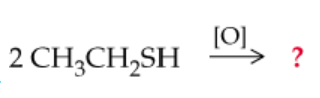
Complete the following equations (Hint: Answers may include concepts learned from previous organic chapters):
c. Chemical equation showing the oxidation of 2 CH3CH2SH with an unknown product indicated by a question mark.

검증된 단계별 안내
1
Identify the type of reaction taking place in the given equation. For example, determine if it is a substitution, addition, elimination, or oxidation-reduction reaction. This will guide how the reactants transform into products.
Analyze the functional groups present in the reactants. Functional groups such as alcohols, alkenes, alkynes, or carbonyl groups often dictate the type of reaction and the products formed.
Apply the appropriate reaction mechanism or rule. For example, if the reaction involves an alkene, consider Markovnikov's or anti-Markovnikov's rule for addition reactions, or if it involves an alcohol, consider oxidation or dehydration pathways.
Balance the chemical equation by ensuring that the number of atoms of each element is the same on both sides of the equation. Also, ensure that the charges are balanced if ions are involved.
Double-check the products to ensure they are consistent with the reaction type and the reagents used. Verify that the stereochemistry (if applicable) and connectivity of atoms in the products are correct.

비슷한 문제에 대한 검증된 영상 답변:

이 영상 해법은 위 문제에 도움이 된다고 튜터들이 추천한 것입니다.
도움이 되었나요?

주요 개념

질문에 올바르게 답하기 위해 반드시 이해해야 하는 핵심 개념들은 다음과 같습니다.

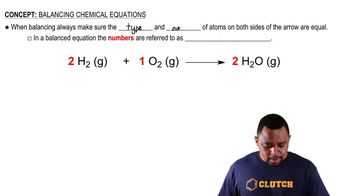
Chemical Equations

Chemical equations represent the transformation of reactants into products during a chemical reaction. They provide a concise way to convey the quantities and types of substances involved, using symbols and formulas. Understanding how to balance these equations is crucial, as it reflects the law of conservation of mass, ensuring that the number of atoms remains constant throughout the reaction.
추천 영상:
가이드 코스
01:32
Balancing Chemical Equations (Simplified) Concept 1

Functional Groups

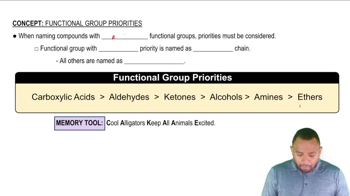
Functional groups are specific groups of atoms within molecules that are responsible for the characteristic chemical reactions of those molecules. In organic chemistry, recognizing functional groups is essential for predicting the behavior of compounds during reactions. Examples include hydroxyl (-OH), carboxyl (-COOH), and amino (-NH2) groups, each imparting unique properties to the molecules they are part of.
추천 영상:
가이드 코스
1:11
Functional Group Priorities Concept 1

Reaction Mechanisms

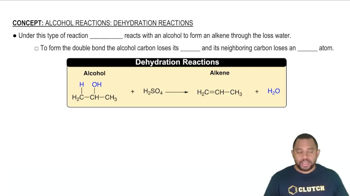
Reaction mechanisms describe the step-by-step process by which reactants are converted into products in a chemical reaction. Understanding these mechanisms helps in predicting the outcomes of reactions and the conditions required for them to occur. Key concepts include intermediates, transition states, and the energy changes associated with each step, which are vital for grasping how and why reactions proceed in a particular manner.
추천 영상:
가이드 코스
1:30
Alcohol Reactions: Dehydration Reactions Concept 1