Ch.16 Amines
McMurry - Fundamentals of General, Organic, and Biological Chemistry 8th Edition
McMurry8th EditionFundamentals of General, Organic, and Biological ChemistryISBN: 9780134015187당신이 사용하는 게 아니라요?교과서 변경
16장, 문제 50

How do amines differ from analogous alcohols in (a) odor, (b) basicity, and (c) boiling point?

검증된 단계별 안내
1
Amines and alcohols are both organic compounds, but they differ in their functional groups. Amines contain a nitrogen atom bonded to one or more alkyl or aryl groups, while alcohols contain a hydroxyl (-OH) group. These differences in structure lead to variations in their properties. Let's address each part of the question:
(a) Odor: Amines typically have a strong, fishy odor due to the presence of the nitrogen atom, which contributes to their characteristic smell. Alcohols, on the other hand, often have a milder, more pleasant odor, especially in lower molecular weight alcohols like ethanol.
(b) Basicity: Amines are generally more basic than alcohols. This is because the nitrogen atom in amines has a lone pair of electrons that can readily accept a proton (H⁺), making them good bases. Alcohols are less basic because the oxygen atom in the hydroxyl group is more electronegative, holding onto its lone pairs more tightly and making it less likely to accept a proton.
(c) Boiling Point: Alcohols typically have higher boiling points than analogous amines. This is due to the strong hydrogen bonding between alcohol molecules, which arises from the highly polar O-H bond. Amines can also form hydrogen bonds, but the N-H bond is less polar than the O-H bond, resulting in weaker intermolecular forces and lower boiling points compared to alcohols of similar molecular weight.
In summary, amines and alcohols differ in odor (amines have a fishy smell, alcohols are milder), basicity (amines are more basic), and boiling point (alcohols have higher boiling points due to stronger hydrogen bonding).

비슷한 문제에 대한 검증된 영상 답변:

이 영상 해법은 위 문제에 도움이 된다고 튜터들이 추천한 것입니다.
도움이 되었나요?

주요 개념

질문에 올바르게 답하기 위해 반드시 이해해야 하는 핵심 개념들은 다음과 같습니다.

Amines and Alcohols

Amines are organic compounds derived from ammonia by replacing one or more hydrogen atoms with alkyl or aryl groups. Alcohols, on the other hand, are characterized by the presence of a hydroxyl (-OH) group. The structural differences between these two classes of compounds significantly influence their physical and chemical properties, including odor, basicity, and boiling point.
추천 영상:
가이드 코스
0:54
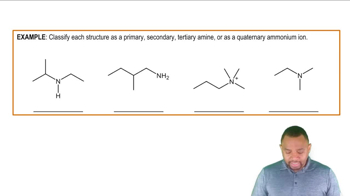
Amine Classification Example 1

Basicity

Basicity refers to the ability of a compound to accept protons (H+) or donate electron pairs. Amines are generally more basic than alcohols due to the presence of a lone pair of electrons on the nitrogen atom, which can readily accept protons. In contrast, the oxygen in alcohols is less basic because it is more electronegative and holds onto its electrons more tightly, making alcohols weaker bases.
추천 영상:
가이드 코스
01:04
Balancing Redox Reactions: Basic Solutions

Boiling Point

The boiling point of a substance is influenced by its molecular structure and intermolecular forces. Amines typically have lower boiling points than alcohols of similar molecular weight due to the presence of hydrogen bonding in alcohols, which is stronger than the dipole-dipole interactions found in amines. This difference in intermolecular forces results in alcohols having higher boiling points compared to their analogous amines.
추천 영상:
가이드 코스
03:05
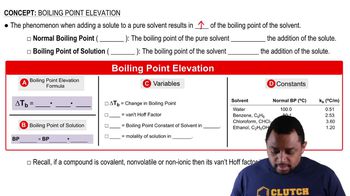
Boiling Point Elevation Concept 1