Ch.16 Amines
McMurry - Fundamentals of General, Organic, and Biological Chemistry 8th Edition
McMurry8th EditionFundamentals of General, Organic, and Biological ChemistryISBN: 9780134015187당신이 사용하는 게 아니라요?교과서 변경
16장, 문제 49

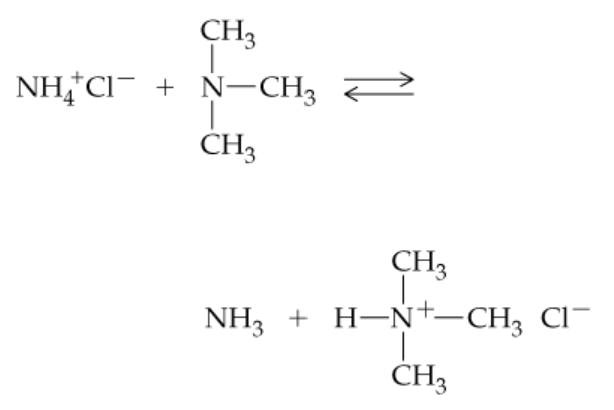
Which is the stronger base, trimethylamine or ammonia? In which direction will the following reaction proceed?
Chemical reaction diagram comparing trimethylamine and ammonia as bases.

검증된 단계별 안내
1
Step 1: Understand the concept of base strength. A stronger base is better at accepting protons (H⁺). The strength of a base is influenced by factors such as the availability of the lone pair of electrons on the nitrogen atom and the surrounding molecular structure.
Step 2: Compare the structures of trimethylamine (N(CH₃)₃) and ammonia (NH₃). Trimethylamine has three methyl groups attached to the nitrogen atom, while ammonia has only hydrogen atoms attached to the nitrogen.
Step 3: Analyze the electron-donating effect of the methyl groups in trimethylamine. Methyl groups are electron-donating, which increases the electron density on the nitrogen atom, making it more available to accept a proton. This suggests that trimethylamine is a stronger base than ammonia.
Step 4: Consider the reaction direction. In a reaction involving a stronger base and a weaker base, the equilibrium will favor the formation of the weaker base because the stronger base will more readily accept a proton. Identify the bases and acids on both sides of the reaction to determine the direction.
Step 5: Use the concept of equilibrium to predict the reaction direction. If trimethylamine is the stronger base, the reaction will proceed in the direction that forms ammonia (the weaker base) and its conjugate acid. Verify this by analyzing the acid-base pairs in the reaction.

비슷한 문제에 대한 검증된 영상 답변:

이 영상 해법은 위 문제에 도움이 된다고 튜터들이 추천한 것입니다.
도움이 되었나요?

주요 개념

질문에 올바르게 답하기 위해 반드시 이해해야 하는 핵심 개념들은 다음과 같습니다.

Brønsted-Lowry Theory of Acids and Bases

The Brønsted-Lowry theory defines acids as proton donors and bases as proton acceptors. This framework helps in understanding the strength of bases by evaluating their ability to accept protons. In this context, comparing trimethylamine and ammonia involves analyzing their respective tendencies to accept protons from acids.
추천 영상:
가이드 코스
02:56
Acid-Base Classification Example

Base Strength

Base strength refers to the ability of a substance to accept protons. In general, stronger bases have a higher tendency to attract protons compared to weaker bases. Trimethylamine, with its three methyl groups, is more sterically hindered than ammonia, which can influence its basicity and the direction of the reaction.
추천 영상:
가이드 코스
00:50
Acid and Base Strength Concept 3

Equilibrium and Reaction Direction

In chemical reactions, the direction in which a reaction proceeds is determined by the relative strengths of the acids and bases involved. The reaction will favor the formation of the weaker acid and weaker base. Understanding the equilibrium concept is crucial for predicting whether trimethylamine or ammonia will act as the stronger base in a given reaction.
추천 영상:
가이드 코스
03:42
Chemical Equilibrium Concept 1