Ch.17 Carboxylic Acids and Their Derivatives
McMurry - Fundamentals of General, Organic, and Biological Chemistry 8th Edition
McMurry8th EditionFundamentals of General, Organic, and Biological ChemistryISBN: 9780134015187당신이 사용하는 게 아니라요?교과서 변경
17장, 문제 1c

Identify the following molecules as a carboxylic acid, an amide, an ester, or none of these.
c. CH3COOH

검증된 단계별 안내
1
Step 1: Begin by analyzing the molecular formula provided, CH₃COOH. Break it down into its functional groups to identify the key components.
Step 2: Recognize that the molecule contains a -COOH group, which is characteristic of carboxylic acids. This functional group consists of a carbon atom double-bonded to an oxygen atom and single-bonded to a hydroxyl group (-OH).
Step 3: Compare the structure of CH₃COOH to the definitions of other functional groups such as amides (-CONH₂), esters (-COOR), and others. Confirm that it does not match the structural criteria for these groups.
Step 4: Recall that carboxylic acids are organic compounds that typically have acidic properties due to the presence of the -COOH group, which can donate a proton (H⁺).
Step 5: Conclude that CH₃COOH is a carboxylic acid based on the presence of the -COOH functional group and its structural characteristics.

비슷한 문제에 대한 검증된 영상 답변:

이 영상 해법은 위 문제에 도움이 된다고 튜터들이 추천한 것입니다.
도움이 되었나요?

주요 개념

질문에 올바르게 답하기 위해 반드시 이해해야 하는 핵심 개념들은 다음과 같습니다.

Carboxylic Acid

Carboxylic acids are organic compounds characterized by the presence of a carboxyl group (-COOH). This functional group consists of a carbon atom double-bonded to an oxygen atom and single-bonded to a hydroxyl group (-OH). They are known for their acidic properties and are commonly found in various biological and industrial processes. An example is acetic acid (CH₃COOH), which is the main component of vinegar.
추천 영상:
가이드 코스
1:09
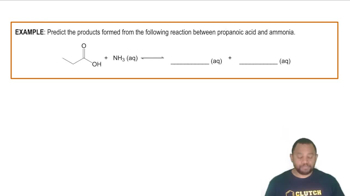
Carboxylic Acid Reactions Example 1

Functional Groups

Functional groups are specific groups of atoms within molecules that are responsible for the characteristic chemical reactions of those molecules. They determine the properties and reactivity of organic compounds. Common functional groups include hydroxyl (-OH), carbonyl (C=O), and carboxyl (-COOH). Identifying these groups is essential for classifying organic compounds into categories such as acids, bases, and esters.
추천 영상:
가이드 코스
1:11
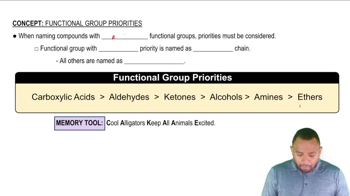
Functional Group Priorities Concept 1

Molecular Classification

Molecular classification involves categorizing organic compounds based on their functional groups and structural features. This classification helps in understanding the chemical behavior and potential reactions of the molecules. For instance, compounds can be classified as carboxylic acids, amides, or esters based on the presence of specific functional groups. This systematic approach is crucial in organic chemistry for predicting reactivity and interactions.
추천 영상:
가이드 코스
02:08
Molecular Formula