Ch.17 Carboxylic Acids and Their Derivatives
McMurry - Fundamentals of General, Organic, and Biological Chemistry 8th Edition
McMurry8th EditionFundamentals of General, Organic, and Biological ChemistryISBN: 9780134015187당신이 사용하는 게 아니라요?교과서 변경
17장, 문제 8a

Write both condensed and line structures for (a) the ester formed when butyric acid reacts with cyclopentanol.

검증된 단계별 안내
1
Step 1: Understand the reaction types. (a) An ester is formed when a carboxylic acid reacts with an alcohol. (b) and (c) Amides are formed when a carboxylic acid reacts with an amine. In each case, the reaction involves the removal of water (a condensation reaction).
Step 2: For part (a), identify the reactants: butyric acid (C3H7COOH) and cyclopentanol (C5H10OH). The ester is formed by replacing the -OH group of the carboxylic acid with the -O- group from the alcohol. Write the condensed structure of the ester and draw the line structure by connecting the cyclopentyl group to the carbonyl carbon of butyric acid.
Step 3: For part (b), identify the reactants: butyric acid (C3H7COOH) and isopropyl amine ((CH3)2CHNH2). The amide is formed by replacing the -OH group of the carboxylic acid with the -NH- group from the amine. Write the condensed structure of the amide and draw the line structure by connecting the isopropyl group to the carbonyl carbon of butyric acid.
Step 4: For part (c), identify the reactants: butyric acid (C3H7COOH) and diethylamine ((C2H5)2NH). The amide is formed by replacing the -OH group of the carboxylic acid with the -N- group from the amine. Write the condensed structure of the amide and draw the line structure by connecting the diethyl group to the carbonyl carbon of butyric acid.
Step 5: For part (d), name the derivatives. (a) The ester is named as an alkyl alkanoate, where the alkyl group comes from the alcohol and the alkanoate comes from the carboxylic acid. (b) and (c) The amides are named as N-substituted alkylamides, where the substituents on the nitrogen are listed, followed by the name of the amide derived from the carboxylic acid.

비슷한 문제에 대한 검증된 영상 답변:

이 영상 해법은 위 문제에 도움이 된다고 튜터들이 추천한 것입니다.
도움이 되었나요?

주요 개념

질문에 올바르게 답하기 위해 반드시 이해해야 하는 핵심 개념들은 다음과 같습니다.

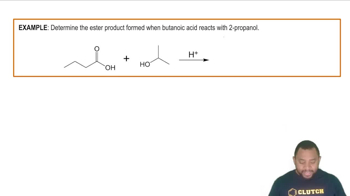
Esterification

Esterification is a chemical reaction between an alcohol and a carboxylic acid, resulting in the formation of an ester and water. In this process, the hydroxyl group (-OH) from the acid and a hydrogen atom from the alcohol combine to release water, while the remaining parts form the ester. Understanding this reaction is crucial for predicting the structure of the ester formed from butyric acid and cyclopentanol.
추천 영상:
가이드 코스
0:46
Ester Reactions: Esterification Example 1

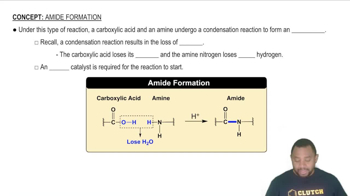
Amide Formation

Amide formation occurs when a carboxylic acid reacts with an amine, resulting in the production of an amide and water. This reaction involves the replacement of the hydroxyl group of the acid with the amine's nitrogen group. Recognizing this mechanism is essential for determining the structures of the amides formed from butyric acid with isopropyl amine and diethylamine.
추천 영상:
가이드 코스
1:41
Amide Formation Concept 1

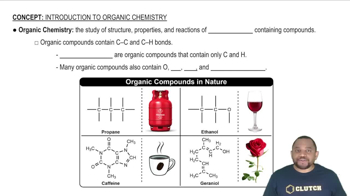
Nomenclature of Organic Compounds

Nomenclature in organic chemistry refers to the systematic naming of chemical compounds based on their structure and functional groups. The International Union of Pure and Applied Chemistry (IUPAC) provides rules for naming esters, amides, and other derivatives, which helps in identifying the compounds created in the reactions. Familiarity with these naming conventions is necessary for accurately naming the derivatives formed in parts (a)–(c).
추천 영상:
가이드 코스
2:26
Introduction to Organic Chemistry Concept 1