Ch.18 Amino Acids and Proteins
McMurry - Fundamentals of General, Organic, and Biological Chemistry 8th Edition
McMurry8th EditionFundamentals of General, Organic, and Biological ChemistryISBN: 9780134015187당신이 사용하는 게 아니라요?교과서 변경
18장, 문제 13

Draw the structure of glutamic acid at low pH, at high pH, and at the two forms that exist between low pH and high pH. Which of these structures represents the zwitterion?

검증된 단계별 안내
1
Understand the structure of glutamic acid: Glutamic acid is an amino acid with the formula C₅H₉NO₄. It contains an amino group (-NH₂), a carboxylic acid group (-COOH), and a side chain with another carboxylic acid group (-CH₂-COOH).
At low pH (acidic conditions): All acidic and basic groups are protonated. The amino group (-NH₂) becomes -NH₃⁺, and both carboxylic acid groups (-COOH) remain in their protonated form. Draw the structure with these groups in their protonated states.
At high pH (basic conditions): All acidic and basic groups are deprotonated. The amino group (-NH₃⁺) loses a proton to become -NH₂, and both carboxylic acid groups (-COOH) lose protons to become -COO⁻. Draw the structure with these groups in their deprotonated states.
Between low and high pH (intermediate pH): Glutamic acid exists in two forms. The first form is the zwitterion, where the amino group is protonated (-NH₃⁺) and one carboxylic acid group is deprotonated (-COO⁻), while the other carboxylic acid group remains protonated (-COOH). The second form occurs when both carboxylic acid groups are deprotonated (-COO⁻), and the amino group remains protonated (-NH₃⁺). Draw both structures.
Identify the zwitterion: The zwitterion is the form of glutamic acid where the molecule has both a positive charge (on the -NH₃⁺ group) and a negative charge (on one -COO⁻ group), but the overall charge is neutral. Confirm this by examining the structure drawn in the previous step.

비슷한 문제에 대한 검증된 영상 답변:

이 영상 해법은 위 문제에 도움이 된다고 튜터들이 추천한 것입니다.
도움이 되었나요?

주요 개념

질문에 올바르게 답하기 위해 반드시 이해해야 하는 핵심 개념들은 다음과 같습니다.

Amino Acid Structure

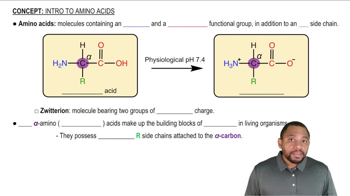
Amino acids, the building blocks of proteins, have a central carbon atom bonded to an amino group, a carboxyl group, a hydrogen atom, and a variable R group. The structure of an amino acid can change based on the pH of the environment, affecting the ionization of the amino and carboxyl groups.
추천 영상:
가이드 코스
3:03
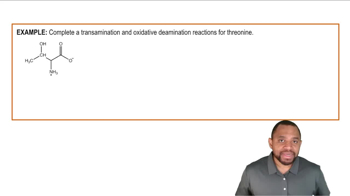
Amino Acid Catabolism: Amino Group Example 2

Zwitterion

A zwitterion is a molecule that has both positive and negative charges but is overall electrically neutral. In the case of amino acids like glutamic acid, at a specific pH (usually around the isoelectric point), the amino group is protonated (positively charged) while the carboxyl group is deprotonated (negatively charged), resulting in a zwitterionic form.
추천 영상:
가이드 코스
3:04
Intro to Amino Acids Concept 1

pH and Ionization

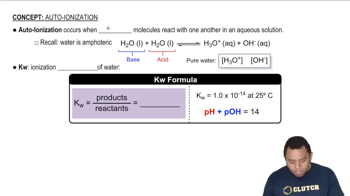
pH is a measure of the acidity or basicity of a solution, influencing the ionization state of functional groups in amino acids. At low pH, amino acids tend to be fully protonated, while at high pH, they are mostly deprotonated. Understanding how pH affects the ionization of glutamic acid is crucial for drawing its structures at different pH levels.
추천 영상:
가이드 코스
02:22
Auto-Ionization and Kw