Ch.18 Amino Acids and Proteins
McMurry - Fundamentals of General, Organic, and Biological Chemistry 8th Edition
McMurry8th EditionFundamentals of General, Organic, and Biological ChemistryISBN: 9780134015187당신이 사용하는 게 아니라요?교과서 변경
18장, 문제 10

Is serine chiral? Draw serine and identify the chiral atom. Explain why serine is chiral.

검증된 단계별 안내
1
Step 1: Begin by understanding the structure of serine. Serine is an amino acid with the molecular formula C₃H₇NO₃. It contains an amino group (-NH₂), a carboxyl group (-COOH), a hydroxyl group (-OH), and a side chain with a single hydrogen atom attached to the central carbon atom.
Step 2: Draw the structure of serine. Place the central carbon atom (called the alpha carbon) at the center. Attach the amino group (-NH₂), the carboxyl group (-COOH), the hydroxyl group (-OH), and a hydrogen atom to the alpha carbon. Ensure that the groups are arranged tetrahedrally around the alpha carbon.
Step 3: Identify the chiral center. A chiral center is a carbon atom that is bonded to four different groups. In serine, the alpha carbon is bonded to four distinct groups: the amino group (-NH₂), the carboxyl group (-COOH), the hydroxyl group (-OH), and a hydrogen atom.
Step 4: Explain why serine is chiral. Since the alpha carbon in serine is bonded to four different groups, it lacks a plane of symmetry and cannot be superimposed on its mirror image. This property makes serine a chiral molecule.
Step 5: Conclude by noting that the presence of a chiral center in serine means it can exist as two enantiomers (non-superimposable mirror images), which are designated as L-serine and D-serine based on their spatial arrangement.

비슷한 문제에 대한 검증된 영상 답변:

이 영상 해법은 위 문제에 도움이 된다고 튜터들이 추천한 것입니다.
도움이 되었나요?

주요 개념

질문에 올바르게 답하기 위해 반드시 이해해야 하는 핵심 개념들은 다음과 같습니다.

Chirality

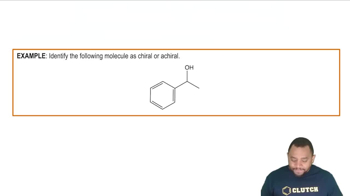
Chirality refers to the geometric property of a molecule that makes it non-superimposable on its mirror image. A chiral molecule typically has at least one carbon atom bonded to four different substituents, creating two distinct forms known as enantiomers. This property is crucial in biochemistry, as the different enantiomers can have vastly different biological activities.
추천 영상:
가이드 코스
1:39
Chirality Example 1

Amino Acids

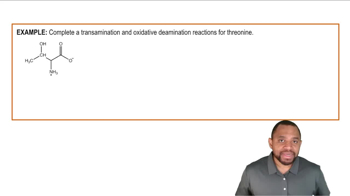
Amino acids are organic compounds that serve as the building blocks of proteins. Each amino acid consists of a central carbon atom (the alpha carbon) bonded to an amino group, a carboxyl group, a hydrogen atom, and a variable side chain (R group). The structure and properties of the side chain determine the characteristics of the amino acid, including its chirality.
추천 영상:
가이드 코스
3:03
Amino Acid Catabolism: Amino Group Example 2

Serine Structure

Serine is a polar amino acid with the chemical formula C3H7NO3. Its structure includes a central carbon atom bonded to an amino group, a carboxyl group, a hydrogen atom, and a hydroxymethyl side chain (-CH2OH). The presence of four different groups attached to the alpha carbon makes serine chiral, allowing it to exist in two enantiomeric forms.
추천 영상:
가이드 코스
1:01
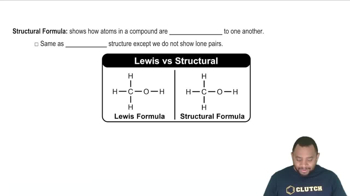
Structural Formula Concept 2