Ch.18 Amino Acids and Proteins
McMurry - Fundamentals of General, Organic, and Biological Chemistry 8th Edition
McMurry8th EditionFundamentals of General, Organic, and Biological ChemistryISBN: 9780134015187당신이 사용하는 게 아니라요?교과서 변경
18장, 문제 34d

Draw the structure of the following amino acids, dipeptides, and tripeptides at low pH (pH 1) and high pH (pH 14). At each pH, assume that all functional groups that might do so are ionized.
d. Glu-Asp

검증된 단계별 안내
1
Step 1: Understand the problem. You are tasked with drawing the structures of the dipeptide Glu-Asp (glutamic acid and aspartic acid) at two different pH levels: low pH (pH 1) and high pH (pH 14). At each pH, you need to account for the ionization states of all functional groups.
Step 2: Recall the structure of glutamic acid (Glu) and aspartic acid (Asp). Both are amino acids with a central alpha carbon bonded to an amino group (-NH2), a carboxyl group (-COOH), a hydrogen atom, and a side chain. Glu has a side chain with a carboxylic acid group (-CH2-COOH), while Asp has a shorter side chain with a carboxylic acid group (-CH2-COOH).
Step 3: At low pH (pH 1), the environment is highly acidic. All carboxyl groups (-COOH) will remain protonated, and the amino groups (-NH2) will gain a proton to become -NH3+. Draw the dipeptide Glu-Asp with the following features: (1) The N-terminal amino group of Glu is protonated (-NH3+), (2) the carboxyl group of Glu's side chain is protonated (-COOH), (3) the carboxyl group of Asp's side chain is protonated (-COOH), and (4) the C-terminal carboxyl group of Asp is protonated (-COOH).
Step 4: At high pH (pH 14), the environment is highly basic. All carboxyl groups (-COOH) will lose a proton to become carboxylate ions (-COO-), and the amino groups (-NH2) will remain unprotonated. Draw the dipeptide Glu-Asp with the following features: (1) The N-terminal amino group of Glu is unprotonated (-NH2), (2) the carboxyl group of Glu's side chain is deprotonated (-COO-), (3) the carboxyl group of Asp's side chain is deprotonated (-COO-), and (4) the C-terminal carboxyl group of Asp is deprotonated (-COO-).
Step 5: Combine the structures for both pH conditions into a clear representation. Ensure that the peptide bond between Glu and Asp is correctly drawn, and label the ionization states of all functional groups at both pH 1 and pH 14. This will help visualize how the dipeptide's structure changes with pH.

비슷한 문제에 대한 검증된 영상 답변:

이 영상 해법은 위 문제에 도움이 된다고 튜터들이 추천한 것입니다.

주요 개념

질문에 올바르게 답하기 위해 반드시 이해해야 하는 핵심 개념들은 다음과 같습니다.

Amino Acid Structure

Amino acids are organic compounds that serve as the building blocks of proteins. Each amino acid consists of a central carbon atom, an amino group (–NH2), a carboxyl group (–COOH), a hydrogen atom, and a variable side chain (R group). The structure and properties of the side chain determine the amino acid's characteristics and behavior in different pH environments.
추천 영상:
가이드 코스
3:03
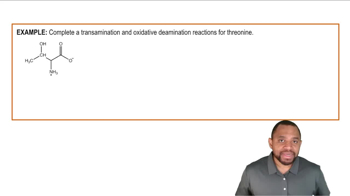
Amino Acid Catabolism: Amino Group Example 2

Ionization at Different pH Levels

The ionization state of amino acids and peptides changes with pH due to the protonation and deprotonation of functional groups. At low pH (acidic conditions), amino groups are typically protonated, while carboxyl groups may remain protonated. Conversely, at high pH (basic conditions), carboxyl groups tend to lose protons, leading to a negatively charged state. Understanding these changes is crucial for accurately drawing structures at varying pH levels.
추천 영상:
가이드 코스
02:22
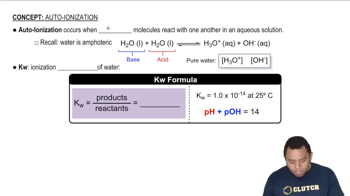
Auto-Ionization and Kw

Peptide Bond Formation

Peptides are formed by the covalent bonding of amino acids through peptide bonds, which occur between the carboxyl group of one amino acid and the amino group of another. This process releases a molecule of water (condensation reaction). The sequence and composition of amino acids in a peptide influence its overall structure and function, making it essential to consider when drawing dipeptides and tripeptides like Glu-Asp.
추천 영상:
가이드 코스
2:19
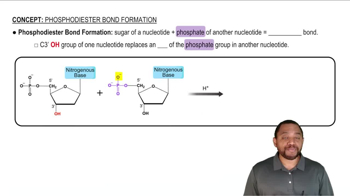
Phosphodiester Bond Formation Concept 1
관련 실천
교과서 질문

Draw the structure of the following amino acids, dipeptides, and tripeptides at low pH (pH 1) and high pH (pH 14). At each pH, assume that all functional groups that might do so are ionized.

a. Val

20
views

교과서 질문

Another endoprotease is trypsin. Trypsin hydrolyzes peptide bonds on the carboxyl side of lysine and arginine. If the following peptide sequence is hydrolyzed by trypsin, how many fragments will there be? Use the three-letter amino acid abbreviations to write the fragments out.

 Ala-Phe-Lys-Cys-Gly-Asp-Arg-Leu-Leu-Phe-Gly-Ala

교과서 질문

Draw the structure of the following amino acids, dipeptides, and tripeptides at low pH (pH 1) and high pH (pH 14). At each pH, assume that all functional groups that might do so are ionized.

e. Gln-Ala-Asn

290
views
교과서 질문

If the same peptide found in Problem 18.32 is subjected to acid hydrolysis, how many fragments will result? Why?

Ala-Phe-Lys-Cys-Gly-Asp-Arg-Leu-Leu-Phe-Gly-Ala

교과서 질문

Draw the hexapeptide Asp-Gly-Phe-Leu-Glu-Ala in linear form showing all of the atoms, and show (using dotted lines) the hydrogen bonding that stabilizes this structure if it is part of an α-helix.

630
views
교과서 질문

Interactions of amino acids on the interior of proteins are key to the shapes of proteins. In group (a), which pairs of amino acids form hydrophobic interactions? In group (b), which pairs form ionic interactions? Which pairs in group (c) form hydrogen bonds?

a. 1 Pro . . . Phe

   2 Lys . . . Ser

   3 Thr . . . Leu

   4 Ala . . . Gly

132
views