Ch.18 Amino Acids and Proteins
McMurry - Fundamentals of General, Organic, and Biological Chemistry 8th Edition
McMurry8th EditionFundamentals of General, Organic, and Biological ChemistryISBN: 9780134015187당신이 사용하는 게 아니라요?교과서 변경
18장, 문제 86a

How do the following noncovalent interactions help to stabilize the tertiary and quaternary structure of a protein? Give an example of a pair of amino acids that could give rise to each interaction.
a. Hydrophobic interactions

검증된 단계별 안내
1
Understand the concept of hydrophobic interactions: These occur when nonpolar (hydrophobic) side chains of amino acids cluster together to avoid contact with water. This minimizes the disruption of hydrogen bonding in the surrounding aqueous environment, stabilizing the protein structure.
Recognize the role of hydrophobic interactions in protein folding: In the tertiary structure, hydrophobic side chains are typically buried in the interior of the protein, away from water, while hydrophilic side chains are exposed on the surface. This arrangement contributes to the overall stability of the protein.
Identify amino acids with nonpolar side chains: Examples of amino acids that participate in hydrophobic interactions include leucine, isoleucine, valine, phenylalanine, and alanine. These amino acids have side chains that are nonpolar and hydrophobic.
Provide an example of a pair of amino acids: A pair such as leucine and valine could interact through hydrophobic interactions. Their nonpolar side chains would cluster together in the protein's interior to avoid water.
Relate hydrophobic interactions to protein structure: These interactions help stabilize the tertiary structure by driving the folding process, ensuring that the protein adopts a functional three-dimensional shape. In quaternary structures, hydrophobic interactions can also stabilize the association between different protein subunits.

비슷한 문제에 대한 검증된 영상 답변:

이 영상 해법은 위 문제에 도움이 된다고 튜터들이 추천한 것입니다.
도움이 되었나요?

주요 개념

질문에 올바르게 답하기 위해 반드시 이해해야 하는 핵심 개념들은 다음과 같습니다.

Hydrophobic Interactions

Hydrophobic interactions occur when nonpolar amino acids aggregate to avoid contact with water, which stabilizes protein structures. This phenomenon is crucial in the folding of proteins, as it drives the formation of a hydrophobic core, minimizing the exposure of hydrophobic side chains to the aqueous environment. An example of amino acids involved in this interaction is phenylalanine and leucine.
추천 영상:
가이드 코스
2:41
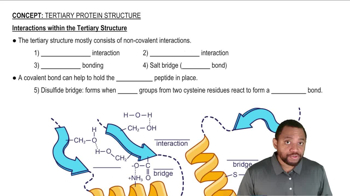
Interactions within the Tertiary Structure Concept 2

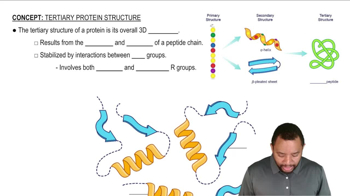
Tertiary Structure

The tertiary structure of a protein refers to its three-dimensional shape formed by the folding of the polypeptide chain. This structure is stabilized by various interactions, including hydrophobic interactions, hydrogen bonds, ionic bonds, and disulfide bridges. The specific arrangement of amino acids in the tertiary structure is critical for the protein's functionality.
추천 영상:
가이드 코스
2:07
Tertiary Protein Structure Concept 1

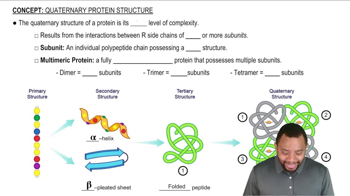
Quaternary Structure

Quaternary structure refers to the assembly of multiple polypeptide chains into a single functional protein complex. This structure is stabilized by noncovalent interactions, such as hydrophobic interactions and hydrogen bonds, between the different subunits. An example of quaternary structure is hemoglobin, which consists of four polypeptide chains that work together to transport oxygen.
추천 영상:
가이드 코스
3:26
Quaternary Protein Structure Concept 1