
Ch.20 Carbohydrates
McMurry - Fundamentals of General, Organic, and Biological Chemistry 8th Edition
McMurry8th EditionFundamentals of General, Organic, and Biological ChemistryISBN: 9780134015187당신이 사용하는 게 아니라요?교과서 변경
20장, 문제 31d

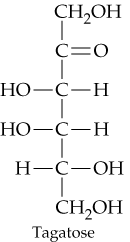
Classify the four carbohydrates (a)–(d) by indicating the nature of the carbonyl group and the number of carbon atoms present. For example, glucose is an aldohexose.
d. Structural formula of Tagatose, showing its carbonyl group and carbon atom arrangement.

검증된 단계별 안내
1
Step 1: Understand the classification of carbohydrates. Carbohydrates are classified based on two main criteria: (1) the type of carbonyl group present (aldehyde or ketone), and (2) the number of carbon atoms in the molecule. For example, an 'aldohexose' is a carbohydrate with an aldehyde group and six carbon atoms.
Step 2: Examine the structure of each carbohydrate provided in the problem. Look for the functional group that contains the carbonyl (C=O). If the carbonyl group is at the end of the chain, it is an aldehyde, and the carbohydrate is classified as an 'aldo-'. If the carbonyl group is within the chain, it is a ketone, and the carbohydrate is classified as a 'keto-'.
Step 3: Count the number of carbon atoms in the structure of each carbohydrate. This will determine the suffix of the classification. For example, 3 carbons = triose, 4 carbons = tetrose, 5 carbons = pentose, and 6 carbons = hexose.
Step 4: Combine the information from Steps 2 and 3 to classify each carbohydrate. For example, if a carbohydrate has an aldehyde group and six carbon atoms, it is an aldohexose. If it has a ketone group and five carbon atoms, it is a ketopentose.
Step 5: Repeat the process for all four carbohydrates (a)–(d) provided in the problem. Carefully analyze each structure to determine the nature of the carbonyl group and the number of carbon atoms, then assign the appropriate classification.

비슷한 문제에 대한 검증된 영상 답변:

이 영상 해법은 위 문제에 도움이 된다고 튜터들이 추천한 것입니다.
영상 길이:
1m
도움이 되었나요?

주요 개념

질문에 올바르게 답하기 위해 반드시 이해해야 하는 핵심 개념들은 다음과 같습니다.

Carbonyl Group

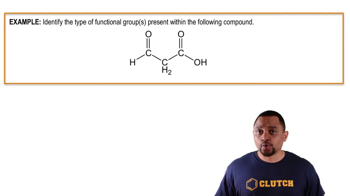
The carbonyl group is a functional group characterized by a carbon atom double-bonded to an oxygen atom (C=O). In carbohydrates, the nature of the carbonyl group determines whether the sugar is classified as an aldose (with an aldehyde group at the end of the carbon chain) or a ketose (with a ketone group within the carbon chain). This classification is essential for identifying the type of carbohydrate.
추천 영상:
가이드 코스
1:00
Functional Groups with Carbonyls Example 3

Number of Carbon Atoms

The number of carbon atoms in a carbohydrate is crucial for its classification. Carbohydrates are often categorized based on the number of carbon atoms they contain, such as triose (3), tetrose (4), pentose (5), hexose (6), and so on. This classification helps in understanding the structure and function of the carbohydrate, as different carbon counts can lead to different properties and biological roles.
추천 영상:
가이드 코스
5:36
Amino Acid Catabolism: Carbon Atoms Concept 2

Carbohydrate Classification

Carbohydrates are classified into simple sugars (monosaccharides) and complex carbohydrates (oligosaccharides and polysaccharides). Monosaccharides can be further classified based on the type of carbonyl group and the number of carbon atoms. Understanding this classification is essential for analyzing the structure and reactivity of carbohydrates, as well as their roles in biological systems.
추천 영상:
가이드 코스
1:29
Classification of Carbohydrates Example 1