
Ch.20 Carbohydrates
McMurry - Fundamentals of General, Organic, and Biological Chemistry 8th Edition
McMurry8th EditionFundamentals of General, Organic, and Biological ChemistryISBN: 9780134015187당신이 사용하는 게 아니라요?교과서 변경
20장, 문제 27

In solution, glucose exists predominantly in the cyclic hemiacetal form, which does not contain an aldehyde group. How is it possible for mild oxidizing agents to oxidize glucose?

검증된 단계별 안내
1
Understand the structure of glucose: Glucose is an aldohexose, meaning it contains an aldehyde group in its open-chain form. However, in aqueous solution, glucose predominantly exists in a cyclic hemiacetal form, which does not have a free aldehyde group.
Recognize the equilibrium between forms: Even though the cyclic form is predominant, glucose exists in equilibrium with its open-chain form. This means that a small fraction of glucose molecules are always present in the open-chain form, which contains the reactive aldehyde group.
Explain the role of mild oxidizing agents: Mild oxidizing agents, such as Benedict's or Fehling's solution, can react with the aldehyde group in the open-chain form of glucose. This reaction oxidizes the aldehyde group to a carboxylic acid group, forming gluconic acid.
Describe the dynamic process: As the aldehyde group in the open-chain form is oxidized, the equilibrium shifts to produce more open-chain glucose from the cyclic form. This ensures that the oxidation reaction can continue until all the glucose is oxidized.
Summarize the key concept: The ability of glucose to be oxidized by mild oxidizing agents is due to the dynamic equilibrium between its cyclic and open-chain forms, allowing the aldehyde group in the open-chain form to participate in the reaction.

비슷한 문제에 대한 검증된 영상 답변:

이 영상 해법은 위 문제에 도움이 된다고 튜터들이 추천한 것입니다.
영상 길이:
2m
도움이 되었나요?

주요 개념

질문에 올바르게 답하기 위해 반드시 이해해야 하는 핵심 개념들은 다음과 같습니다.

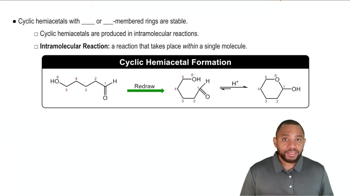
Cyclic Hemiacetal Form

Glucose primarily exists in a cyclic hemiacetal form, where the aldehyde group reacts with a hydroxyl group to form a ring structure. This transformation occurs when glucose is in solution, making it more stable. In this form, the aldehyde group is no longer free, which raises the question of how glucose can still undergo oxidation.
추천 영상:
가이드 코스
2:55
Cyclic Hemiacetals Concept 2

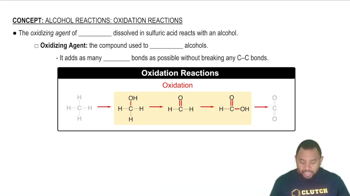
Oxidation of Alcohols

Mild oxidizing agents can oxidize alcohols, including the hydroxyl groups present in glucose. In the case of glucose, the primary alcohol group at the C6 position can be oxidized to form an aldehyde or carboxylic acid. This process is facilitated by the presence of the cyclic structure, which allows for the reactivity of the hydroxyl groups.
추천 영상:
가이드 코스
1:49
Alcohol Reactions: Oxidation Concept 1

Reducing and Oxidizing Agents

Reducing agents donate electrons, while oxidizing agents accept them. Mild oxidizing agents, such as Benedict's solution or Tollens' reagent, can selectively oxidize certain functional groups in carbohydrates. In glucose, the ability of these agents to interact with the hydroxyl groups enables the oxidation process, despite the absence of a free aldehyde group in its cyclic form.
추천 영상:
가이드 코스
1:01
Ketoses as Reducing Sugars Example 2