D-Fructose can form a six-membered cyclic hemiacetal as well as the more prevalent five-membered cyclic form. Draw the α isomer of D-fructose in the six-membered ring.
Ch.20 Carbohydrates
McMurry8th EditionFundamentals of General, Organic, and Biological ChemistryISBN: 9780134015187당신이 사용하는 게 아니라요?교과서 변경
20장, 문제 83
Describe the differences between mono-, di-, and polysaccharides.
검증된 단계별 안내1
Monosaccharides are the simplest form of carbohydrates and consist of a single sugar unit. Examples include glucose (C₆H₁₂O₆) and fructose. They are the building blocks for more complex carbohydrates.
Disaccharides are carbohydrates composed of two monosaccharide units joined together by a glycosidic bond. Examples include sucrose (table sugar), which is made of glucose and fructose, and lactose, which is made of glucose and galactose.
Polysaccharides are complex carbohydrates made up of many monosaccharide units linked together in long chains. Examples include starch, glycogen, and cellulose. These serve as energy storage (e.g., starch in plants, glycogen in animals) or structural components (e.g., cellulose in plant cell walls).
The key difference lies in their structure: monosaccharides are single units, disaccharides are two units, and polysaccharides are long chains of units. This structural difference also affects their properties, such as solubility and digestibility.
In terms of function, monosaccharides are quick energy sources, disaccharides provide slightly more complex energy storage, and polysaccharides serve as long-term energy reserves or structural materials in organisms.

비슷한 문제에 대한 검증된 영상 답변:
이 영상 해법은 위 문제에 도움이 된다고 튜터들이 추천한 것입니다.
영상 길이:
4m도움이 되었나요?
주요 개념
질문에 올바르게 답하기 위해 반드시 이해해야 하는 핵심 개념들은 다음과 같습니다.
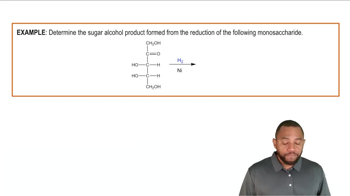
Monosaccharides
Monosaccharides are the simplest form of carbohydrates, consisting of single sugar molecules. They serve as the building blocks for more complex carbohydrates and include glucose, fructose, and galactose. These sugars are easily absorbed by the body and provide quick energy.
추천 영상:
가이드 코스
Reduction of Monosaccharides Example 1
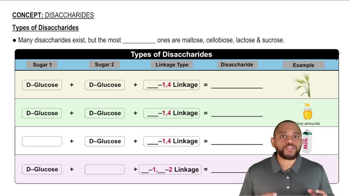
Disaccharides
Disaccharides are carbohydrates formed by the combination of two monosaccharide molecules through a glycosidic bond. Common examples include sucrose (table sugar), lactose (milk sugar), and maltose. They are broken down into their monosaccharide components during digestion before being utilized for energy.
추천 영상:
가이드 코스
Types of Disaccharides Concept 1
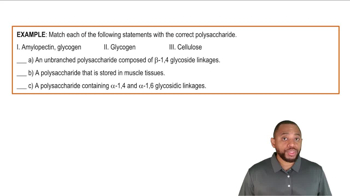
Polysaccharides
Polysaccharides are complex carbohydrates composed of long chains of monosaccharide units linked together. They serve various functions, such as energy storage (e.g., starch in plants and glycogen in animals) and structural support (e.g., cellulose in plant cell walls). Due to their complexity, they are digested more slowly than monosaccharides and disaccharides.
추천 영상:
가이드 코스
Polysaccharides Example 1
관련 실천
교과서 질문
531
views
교과서 질문
Are the α and β forms of the disaccharide lactose enantiomers of each other? Why or why not?
1005
views
교과서 질문
Trehalose, a disaccharide found in the blood of insects, has the following structure. What simple sugars would you obtain on hydrolysis of trehalose? (Hint: Rotate one of the rings in your head or redraw it rotated.)
1117
views
교과서 질문
Carbohydrates provide 4 kcal per gram. If a person eats 200 g per day of digestible carbohydrates, what percentage of a 2000 kcal daily diet would be digestible carbohydrate?
746
views
교과서 질문
Name a naturally occurring carbohydrate and its source for each type of carbohydrate listed in Problem 20.83.
666
views