Ch.20 Carbohydrates
McMurry - Fundamentals of General, Organic, and Biological Chemistry 8th Edition
McMurry8th EditionFundamentals of General, Organic, and Biological ChemistryISBN: 9780134015187당신이 사용하는 게 아니라요?교과서 변경
20장, 문제 50

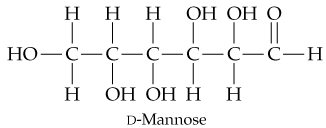
In its open-chain form, D-mannose, an aldohexose found in orange peels, has the structure shown here. Coil mannose around and draw it in the cyclic hemiacetal ⍺ and β forms.

검증된 단계별 안내
1
Understand that d-mannose is an aldohexose, meaning it contains six carbon atoms and an aldehyde functional group. In its open-chain form, the aldehyde group is at the top (C1), and the hydroxyl groups (-OH) are attached to the other carbons in a specific stereochemical arrangement.
To form the cyclic hemiacetal, recognize that the aldehyde group at C1 reacts with the hydroxyl group on C5. This reaction creates a new ring structure, specifically a six-membered ring (pyranose form).
When the ring closes, a new chiral center is formed at C1 (the anomeric carbon). This results in two possible stereoisomers: the α-anomer (where the -OH group on the anomeric carbon is trans to the CH2OH group at C5) and the ß-anomer (where the -OH group on the anomeric carbon is cis to the CH2OH group at C5).
Draw the cyclic structure of d-mannose in its α form. Start by sketching a six-membered ring with oxygen as one of the members. Place the CH2OH group at C5 above the plane of the ring, and position the -OH group on the anomeric carbon (C1) below the plane of the ring.
Draw the cyclic structure of d-mannose in its ß form. Use the same six-membered ring structure, but this time, position the -OH group on the anomeric carbon (C1) above the plane of the ring, making it cis to the CH2OH group at C5.

비슷한 문제에 대한 검증된 영상 답변:

이 영상 해법은 위 문제에 도움이 된다고 튜터들이 추천한 것입니다.
영상 길이:
8m
도움이 되었나요?

주요 개념

질문에 올바르게 답하기 위해 반드시 이해해야 하는 핵심 개념들은 다음과 같습니다.

Aldohexose

Aldohexoses are a type of monosaccharide that contain six carbon atoms and an aldehyde group. D-mannose, specifically, is an aldohexose that plays a crucial role in various biological processes, including cell recognition and metabolism. Understanding its structure is essential for grasping how it interacts in biological systems.

Cyclic Hemiacetal Formation

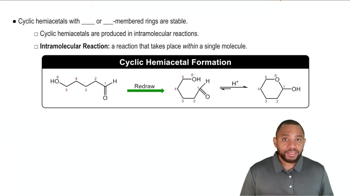
Cyclic hemiacetals are formed when a monosaccharide reacts with itself, leading to a ring structure. In the case of d-mannose, this process involves the reaction of the aldehyde group with a hydroxyl group on the same molecule, resulting in two anomeric forms: α and ß. This transformation is vital for understanding the stability and reactivity of sugars in solution.
추천 영상:
가이드 코스
2:55
Cyclic Hemiacetals Concept 2

Anomeric Forms

Anomeric forms refer to the two different configurations of a sugar molecule at the anomeric carbon, which is the carbon derived from the carbonyl group in the open-chain form. For d-mannose, the α and ß forms differ in the orientation of the hydroxyl group at this carbon. This distinction is important in biochemistry as it affects the sugar's properties and interactions with enzymes and receptors.
추천 영상:
가이드 코스
02:35
Periodic Table: Elemental Forms (Simplified) Concept 1