Ch.20 Carbohydrates
McMurry - Fundamentals of General, Organic, and Biological Chemistry 8th Edition
McMurry8th EditionFundamentals of General, Organic, and Biological ChemistryISBN: 9780134015187당신이 사용하는 게 아니라요?교과서 변경
20장, 문제 52

Treatment of D-glucose with a reducing agent yields sorbitol, a substance used as a sugar substitute by people with diabetes. Draw the structure of sorbitol.

검증된 단계별 안내
1
Understand the context: d-glucose is a monosaccharide (a simple sugar) with an aldehyde functional group (-CHO) at the first carbon. When treated with a reducing agent, the aldehyde group is reduced to a primary alcohol (-CH2OH). This process converts d-glucose into sorbitol, a sugar alcohol.
Identify the structure of d-glucose: d-glucose is a six-carbon sugar (hexose) with the molecular formula C6H12O6. It has a linear form and a cyclic form, but for this reaction, focus on the linear form where the aldehyde group is present at the first carbon.
Apply the reduction reaction: A reducing agent donates electrons to the aldehyde group (-CHO) at the first carbon of d-glucose, converting it into a primary alcohol (-CH2OH). This changes the functional group at the first carbon while leaving the rest of the molecule unchanged.
Draw the structure of sorbitol: After the reduction, the molecule will have six carbons, each with a hydroxyl group (-OH) attached. The first carbon, which originally had the aldehyde group, now has a hydroxyl group (-OH) and a hydrogen (-H), forming a primary alcohol.
Verify the structure: Ensure that the final structure of sorbitol has the correct number of carbons (6), hydrogens (14), and oxygens (6), with hydroxyl groups (-OH) attached to each carbon. This confirms that the reduction of d-glucose to sorbitol is complete.

비슷한 문제에 대한 검증된 영상 답변:

이 영상 해법은 위 문제에 도움이 된다고 튜터들이 추천한 것입니다.
영상 길이:
1m
도움이 되었나요?

주요 개념

질문에 올바르게 답하기 위해 반드시 이해해야 하는 핵심 개념들은 다음과 같습니다.

D-Glucose Structure

D-glucose is a simple sugar (monosaccharide) with the molecular formula C6H12O6. It has a six-carbon backbone and exists in a cyclic form, typically as a pyranose (six-membered ring). Understanding its structure is essential for recognizing how it can be chemically modified to produce other compounds, such as sorbitol.
추천 영상:
가이드 코스
2:48
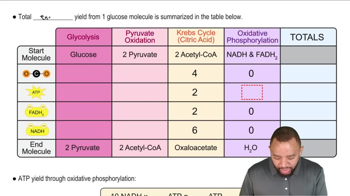
Total Energy From Glucose Concept 2

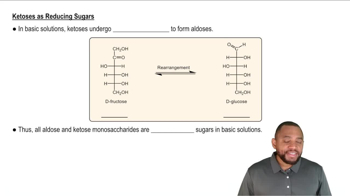
Reducing Agents

Reducing agents are substances that donate electrons in a chemical reaction, leading to the reduction of another substance. In the context of glucose, a reducing agent can convert the aldehyde group of D-glucose into an alcohol group, resulting in the formation of sorbitol. This transformation is crucial for understanding how sugar substitutes are synthesized.
추천 영상:
가이드 코스
1:03
Ketoses as Reducing Sugars Concept 2

Sorbitol Structure

Sorbitol, also known as glucitol, is a sugar alcohol derived from D-glucose. Its structure features a six-carbon chain with hydroxyl (-OH) groups attached to each carbon, making it a polyol. Sorbitol is commonly used as a sugar substitute due to its lower caloric content and minimal impact on blood sugar levels, which is particularly beneficial for individuals with diabetes.
추천 영상:
가이드 코스
1:01
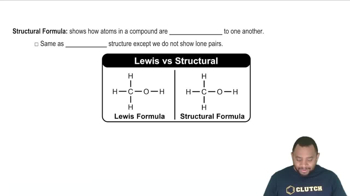
Structural Formula Concept 2