After running a mile, you stop and breathe heavily for a short period due to oxygen debt. Why do you need to breathe so heavily? (Hint: Look up “oxygen debt” on the Web. Which metabolic pathway requires oxygen?)
Ch.21 The Generation of Biochemical Energy
McMurry8th EditionFundamentals of General, Organic, and Biological ChemistryISBN: 9780134015187당신이 사용하는 게 아니라요?교과서 변경
21장, 문제 83
The mitochondrion pumps H+ from the matrix into the intermembrane space. Which region is more acidic, the matrix or the intermembrane space? Why?
검증된 단계별 안내1
Understand the concept of pH and acidity: Acidity is determined by the concentration of hydrogen ions (H+). A region with a higher concentration of H+ ions is more acidic and has a lower pH value.
Recognize the role of the mitochondrion: The mitochondrion actively pumps H+ ions from the matrix into the intermembrane space during cellular respiration, specifically in the electron transport chain.
Compare the regions: Since H+ ions are being moved from the matrix to the intermembrane space, the intermembrane space will have a higher concentration of H+ ions compared to the matrix.
Conclude which region is more acidic: The intermembrane space is more acidic because it has a higher concentration of H+ ions, resulting in a lower pH compared to the matrix.
Explain the significance: This H+ gradient is crucial for ATP synthesis, as the flow of H+ back into the matrix through ATP synthase drives the production of ATP in the process of oxidative phosphorylation.

비슷한 문제에 대한 검증된 영상 답변:
이 영상 해법은 위 문제에 도움이 된다고 튜터들이 추천한 것입니다.
영상 길이:
2m도움이 되었나요?
주요 개념
질문에 올바르게 답하기 위해 반드시 이해해야 하는 핵심 개념들은 다음과 같습니다.
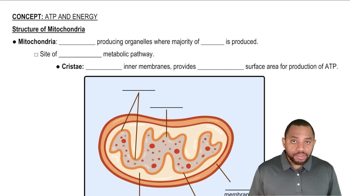
Mitochondrial Structure
The mitochondrion consists of two membranes: the outer membrane and the inner membrane, which encloses the mitochondrial matrix. The space between these membranes is known as the intermembrane space. Understanding this structure is crucial for analyzing how protons (H<sup>+</sup>) are transported and how this affects the acidity of different regions.
추천 영상:
가이드 코스
Structure of Mitochondria Concept 1
Proton Gradient and pH
A proton gradient is created when protons are pumped from the mitochondrial matrix into the intermembrane space, leading to a higher concentration of H<sup>+</sup> ions in the intermembrane space. This increase in proton concentration lowers the pH, making the intermembrane space more acidic compared to the matrix, which has a lower concentration of protons.
추천 영상:
가이드 코스
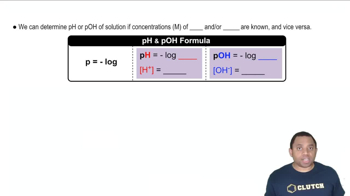
pH and pOH Calculations
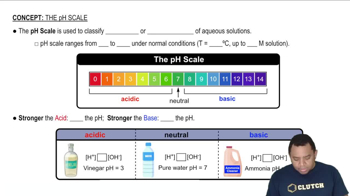
Acidity and pH Scale
Acidity is measured using the pH scale, where lower pH values indicate higher acidity. The pH scale ranges from 0 to 14, with values below 7 being acidic. In the context of the mitochondrion, the intermembrane space, having a higher concentration of protons due to the pumping action, will have a lower pH and thus be more acidic than the matrix.
추천 영상:
가이드 코스
The pH Scale
관련 실천
교과서 질문
1013
views
교과서 질문
With what class of enzymes are the coenzymes NAD+ and FAD associated?
1536
views
교과서 질문
The citric acid cycle contains four 4-carbon dicarboxylic acids.
a. Name them.
705
views
교과서 질문
We talk of burning food in a combustion process, producing CO2 and H2O from food and O2. Explain how O2 is involved in the process although no O2 is directly involved in the citric acid cycle.
1039
views
교과서 질문
If you use a flame to burn a pile of glucose completely to give carbon dioxide and water, the overall reaction is identical to the metabolic oxidation of glucose. Explain the differences in the fate of the energy released in each case.
1129
views
교과서 질문
The citric acid cycle contains four 4-carbon dicarboxylic acids.
b. Arrange them in order from least oxidized to most oxidized.
609
views