Ch.22 Carbohydrate Metabolism
McMurry - Fundamentals of General, Organic, and Biological Chemistry 8th Edition
McMurry8th EditionFundamentals of General, Organic, and Biological ChemistryISBN: 9780134015187당신이 사용하는 게 아니라요?교과서 변경
22장, 문제 50

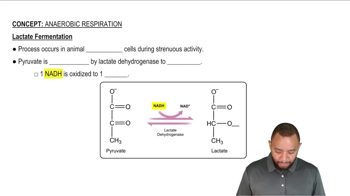
Lactate can be converted into pyruvate by the enzyme lactate dehydrogenase and the coenzyme NAD+. Write the reaction in the standard biochemical format, using a curved arrow to show the involvement of NAD+.

검증된 단계별 안내
1
Understand the context: Lactate is oxidized to pyruvate in a reaction catalyzed by the enzyme lactate dehydrogenase. This reaction involves the coenzyme NAD⁺, which acts as an electron acceptor and is reduced to NADH in the process.
Write the chemical equation for the reaction: Lactate (C₃H₆O₃) + NAD⁺ → Pyruvate (C₃H₄O₃) + NADH + H⁺. This shows the conversion of lactate to pyruvate and the simultaneous reduction of NAD⁺ to NADH.
Identify the electron transfer: In this reaction, a hydrogen atom (with its associated electrons) is removed from lactate and transferred to NAD⁺. This is an oxidation-reduction (redox) reaction.
Use a curved arrow to represent the electron flow: Draw a curved arrow starting from the hydroxyl group (-OH) on lactate, indicating the removal of a hydrogen atom and its electrons. Another curved arrow should show the transfer of these electrons to NAD⁺, resulting in the formation of NADH.
Label the products and reactants: Clearly label lactate as the substrate, pyruvate as the product, NAD⁺ as the oxidizing agent, and NADH as the reduced form of the coenzyme. This helps in understanding the roles of each component in the reaction.

비슷한 문제에 대한 검증된 영상 답변:

이 영상 해법은 위 문제에 도움이 된다고 튜터들이 추천한 것입니다.
영상 길이:
2m
도움이 되었나요?

주요 개념

질문에 올바르게 답하기 위해 반드시 이해해야 하는 핵심 개념들은 다음과 같습니다.

Lactate Dehydrogenase

Lactate dehydrogenase (LDH) is an enzyme that catalyzes the conversion of lactate to pyruvate, a key step in cellular metabolism. This reaction is crucial during anaerobic respiration, where lactate accumulates in muscles. LDH facilitates this conversion by transferring electrons, which is essential for regenerating NAD⁺ from NADH.
추천 영상:
가이드 코스
1:14
Anaerobic Respiration Concept 3

NAD⁺ and NADH

NAD⁺ (Nicotinamide adenine dinucleotide) is a coenzyme that plays a vital role in redox reactions within cells. It acts as an electron carrier, accepting electrons during metabolic processes and becoming reduced to NADH. The regeneration of NAD⁺ from NADH is critical for maintaining metabolic pathways, especially during glycolysis and fermentation.
추천 영상:
가이드 코스
1:43
Intro to Electron Transport Chain Example 1

Biochemical Reaction Representation

In biochemistry, reactions are often represented using a standard format that includes reactants, products, and arrows indicating the direction of the reaction. Curved arrows are used to illustrate the movement of electrons or the formation and breaking of bonds. This notation helps visualize the mechanism of the reaction, including the role of coenzymes like NAD⁺ in facilitating the conversion of substrates.
추천 영상:
가이드 코스
1:08
Energy Production In Biochemical Pathways Example 1