Lactate can be converted into pyruvate by the enzyme lactate dehydrogenase and the coenzyme NAD+. Write the reaction in the standard biochemical format, using a curved arrow to show the involvement of NAD+.
Ch.22 Carbohydrate Metabolism
McMurry8th EditionFundamentals of General, Organic, and Biological ChemistryISBN: 9780134015187당신이 사용하는 게 아니라요?교과서 변경
22장, 문제 61
Name the anabolic pathway for making glucose.
검증된 단계별 안내1
Understand that an anabolic pathway is a metabolic process that builds larger molecules from smaller ones, requiring energy input.
Recognize that the process of making glucose from non-carbohydrate precursors is called gluconeogenesis.
Recall that gluconeogenesis primarily occurs in the liver and, to a lesser extent, in the kidneys.
Note that gluconeogenesis uses substrates such as pyruvate, lactate, glycerol, and certain amino acids to synthesize glucose.
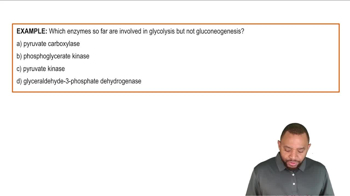
Understand that gluconeogenesis is essentially the reverse of glycolysis, but it bypasses the irreversible steps of glycolysis using specific enzymes like pyruvate carboxylase and phosphoenolpyruvate carboxykinase.

비슷한 문제에 대한 검증된 영상 답변:
이 영상 해법은 위 문제에 도움이 된다고 튜터들이 추천한 것입니다.
영상 길이:
1m도움이 되었나요?
주요 개념
질문에 올바르게 답하기 위해 반드시 이해해야 하는 핵심 개념들은 다음과 같습니다.
Gluconeogenesis
Gluconeogenesis is the metabolic pathway through which organisms synthesize glucose from non-carbohydrate precursors. This process primarily occurs in the liver and, to a lesser extent, in the kidneys. It is crucial during periods of fasting or intense exercise when glucose levels are low, allowing the body to maintain energy homeostasis.
추천 영상:
가이드 코스
Gluconeogenesis Example 2
Anabolic Pathways
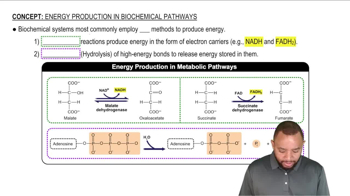
Anabolic pathways are metabolic routes that construct molecules from smaller units, requiring energy input. These pathways are essential for growth, repair, and maintenance of cellular structures. In the context of gluconeogenesis, it represents the synthesis of glucose, contrasting with catabolic pathways that break down molecules to release energy.
추천 영상:
가이드 코스
Energy Production In Biochemical Pathways Concept 1
Substrates of Gluconeogenesis
The substrates of gluconeogenesis include lactate, glycerol, and certain amino acids, which serve as building blocks for glucose synthesis. These substrates are converted through a series of enzymatic reactions, ultimately leading to the formation of glucose. Understanding these substrates is vital for grasping how the body generates glucose from various sources during metabolic stress.
추천 영상:
가이드 코스
Gluconeogenesis Example 2
관련 실천
교과서 질문
897
views
교과서 질문
Name the two molecules that serve as starting materials for glucose synthesis.
821
views
교과서 질문
Explain why the Cori cycle is necessary and when your cells would use this cycle.
686
views
교과서 질문
Differentiate between blood sugar levels and resulting symptoms in hyperglycemia and hypoglycemia.
751
views
교과서 질문
How many steps in gluconeogenesis are not the exact reversal of the steps in glycolysis? What kind of conversion of substrate to product does each involve? What is the common theme in each of these reactions?
728
views
교과서 질문
Why does glycogenolysis use fewer steps than the reverse process, glycogenesis? Which process uses less energy?
1139
views