
Ch.22 Carbohydrate Metabolism
McMurry - Fundamentals of General, Organic, and Biological Chemistry 8th Edition
McMurry8th EditionFundamentals of General, Organic, and Biological ChemistryISBN: 9780134015187당신이 사용하는 게 아니라요?교과서 변경
22장, 문제 11

Pyruvate has three different fates. What are the three different molecules pyruvate is converted into? What conditions exist for the formation of each product?

검증된 단계별 안내
1
Pyruvate is a key intermediate in cellular metabolism, and its fate depends on the cellular conditions. The three main molecules pyruvate can be converted into are lactate, acetyl-CoA, and ethanol. Let's explore each pathway and the conditions under which it occurs.
1. **Conversion to Lactate**: Under anaerobic conditions (lack of oxygen), pyruvate is reduced to lactate by the enzyme lactate dehydrogenase. This process regenerates NAD⁺, which is essential for glycolysis to continue. This occurs in muscle cells during intense exercise or in certain microorganisms.
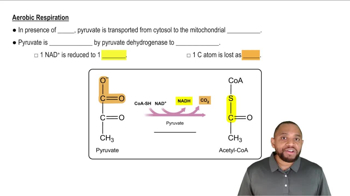
2. **Conversion to Acetyl-CoA**: Under aerobic conditions (presence of oxygen), pyruvate is transported into the mitochondria and converted into acetyl-CoA by the enzyme pyruvate dehydrogenase. Acetyl-CoA then enters the citric acid cycle (Krebs cycle) for further energy production.
3. **Conversion to Ethanol**: In some microorganisms, such as yeast, pyruvate is converted into ethanol and carbon dioxide under anaerobic conditions. This process, known as alcoholic fermentation, involves two steps: (a) pyruvate is decarboxylated to acetaldehyde by the enzyme pyruvate decarboxylase, and (b) acetaldehyde is reduced to ethanol by alcohol dehydrogenase.
These three pathways highlight how pyruvate serves as a metabolic crossroads, with its fate determined by the availability of oxygen and the type of organism or cell involved.

비슷한 문제에 대한 검증된 영상 답변:

이 영상 해법은 위 문제에 도움이 된다고 튜터들이 추천한 것입니다.
영상 길이:
4m
도움이 되었나요?

주요 개념

질문에 올바르게 답하기 위해 반드시 이해해야 하는 핵심 개념들은 다음과 같습니다.

Pyruvate Decarboxylation

Pyruvate decarboxylation is the process by which pyruvate, produced from glycolysis, is converted into acetyl-CoA. This reaction occurs in the mitochondria and is catalyzed by the pyruvate dehydrogenase complex. Acetyl-CoA is a crucial substrate for the Krebs cycle, linking glycolysis to aerobic respiration.
추천 영상:
가이드 코스
1:38
Pyruvate Oxidation Concept 2

Lactic Acid Fermentation

Lactic acid fermentation is an anaerobic process where pyruvate is converted into lactic acid, primarily in muscle cells and certain bacteria. This occurs when oxygen is scarce, allowing for ATP production without the Krebs cycle. It helps regenerate NAD+, which is essential for glycolysis to continue.
추천 영상:

Alcoholic Fermentation

Alcoholic fermentation is another anaerobic process where pyruvate is converted into ethanol and carbon dioxide, primarily by yeast. This process occurs in the absence of oxygen and is utilized in brewing and baking. It also regenerates NAD+, allowing glycolysis to proceed and produce ATP.
추천 영상:
가이드 코스
1:10
Alcohol Classification Concept 2