Ch.22 Carbohydrate Metabolism
McMurry - Fundamentals of General, Organic, and Biological Chemistry 8th Edition
McMurry8th EditionFundamentals of General, Organic, and Biological ChemistryISBN: 9780134015187당신이 사용하는 게 아니라요?교과서 변경
22장, 문제 9a

In alcoholic fermentation, each mole of pyruvate is converted to one mole of carbon dioxide and one mole of ethanol. In the process, about 50 kcal/mol (209 kJ/mol) of energy is produced. Under the most favorable conditions, more than one-half of this energy is stored as ATP.
a. What happens to the remaining energy produced in alcoholic fermentation?

검증된 단계별 안내
1
Understand the context: Alcoholic fermentation is a biological process where glucose is broken down anaerobically to produce ethanol, carbon dioxide, and energy. The energy released is partially stored in ATP, while the rest is dissipated in other forms.
Recall the energy distribution: In this process, about 50 kcal/mol (209 kJ/mol) of energy is released per mole of pyruvate. More than half of this energy is stored in ATP molecules, which are used by the cell for various biological functions.
Identify the fate of the remaining energy: The energy that is not stored in ATP is released as heat. This heat contributes to maintaining the temperature of the organism or the surrounding environment.
Relate to thermodynamics: The release of heat is a natural consequence of the second law of thermodynamics, which states that some energy in any energy transformation is lost as heat and cannot be used to perform work.
Summarize the process: The remaining energy produced in alcoholic fermentation, which is not stored in ATP, is dissipated as heat, ensuring the process adheres to the principles of energy conservation and thermodynamics.

비슷한 문제에 대한 검증된 영상 답변:

이 영상 해법은 위 문제에 도움이 된다고 튜터들이 추천한 것입니다.
영상 길이:
3m
도움이 되었나요?

주요 개념

질문에 올바르게 답하기 위해 반드시 이해해야 하는 핵심 개념들은 다음과 같습니다.

Energy Yield in Fermentation

In alcoholic fermentation, the energy produced from the conversion of pyruvate to ethanol and carbon dioxide is not entirely captured as ATP. While approximately 50 kcal/mol is generated, only about half is stored as ATP, indicating that the remaining energy is released as heat or used in other metabolic processes.
추천 영상:

ATP Production

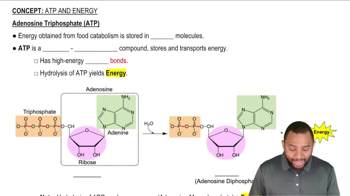
Adenosine triphosphate (ATP) is the primary energy currency of the cell, produced during cellular respiration and fermentation. In alcoholic fermentation, ATP is generated through substrate-level phosphorylation, where energy-rich molecules are directly converted into ATP, but not all energy from glucose is converted into ATP, leading to energy loss.
추천 영상:
가이드 코스
2:20
Adenosine Triphosphate (ATP) Concept 2

Heat Loss in Metabolic Processes

During fermentation, some of the energy released is dissipated as heat, which is a common occurrence in biological systems. This heat loss is a byproduct of metabolic reactions and can affect the efficiency of energy conversion, as it represents energy that is not harnessed for cellular work.
추천 영상: