
Ch.23 Lipids
McMurry - Fundamentals of General, Organic, and Biological Chemistry 8th Edition
McMurry8th EditionFundamentals of General, Organic, and Biological ChemistryISBN: 9780134015187당신이 사용하는 게 아니라요?교과서 변경
23장, 문제 23

A membrane lipid was isolated and completely hydrolyzed. The following products were detected: ethanolamine, phosphate, glycerol, palmitic acid, and oleic acid. Propose a structure for this membrane lipid, and name the family to which it belongs.

검증된 단계별 안내
1
Identify the components of the membrane lipid based on the hydrolysis products: ethanolamine, phosphate, glycerol, palmitic acid, and oleic acid. These components suggest the lipid is a phospholipid, as it contains a phosphate group and glycerol backbone.
Recall the general structure of a phospholipid: it consists of a glycerol backbone, two fatty acid chains (hydrophobic tails), and a polar head group that includes a phosphate group and an additional molecule (in this case, ethanolamine).
Assign the fatty acids to the glycerol backbone. Palmitic acid (a saturated fatty acid) and oleic acid (an unsaturated fatty acid) will be esterified to the first and second hydroxyl groups of glycerol, respectively.
Attach the phosphate group to the third hydroxyl group of glycerol. Then, link the ethanolamine molecule to the phosphate group to form the polar head group. This structure is characteristic of a phosphatidylethanolamine.
Conclude that the membrane lipid belongs to the phospholipid family, specifically the phosphatidylethanolamine subclass, as it contains ethanolamine as the polar head group.

비슷한 문제에 대한 검증된 영상 답변:

이 영상 해법은 위 문제에 도움이 된다고 튜터들이 추천한 것입니다.
영상 길이:
1m
도움이 되었나요?

주요 개념

질문에 올바르게 답하기 위해 반드시 이해해야 하는 핵심 개념들은 다음과 같습니다.

Phospholipids

Phospholipids are a class of lipids that are a major component of all cell membranes. They consist of a glycerol backbone, two fatty acid tails, and a phosphate group. The hydrophilic (water-attracting) phosphate head and hydrophobic (water-repelling) fatty acid tails create a bilayer structure that is fundamental to membrane integrity and function.
추천 영상:
가이드 코스
1:01
Glycerophospholipids Example 1

Fatty Acids

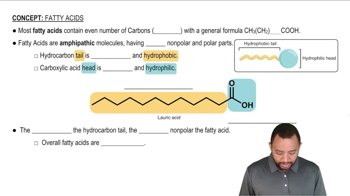
Fatty acids are long hydrocarbon chains that can be saturated (no double bonds) or unsaturated (one or more double bonds). In the context of membrane lipids, the presence of palmitic acid (a saturated fatty acid) and oleic acid (an unsaturated fatty acid) influences the fluidity and flexibility of the membrane, affecting its overall properties and functionality.
추천 영상:
가이드 코스
2:00
Fatty Acids Concept 1

Glycerol Backbone

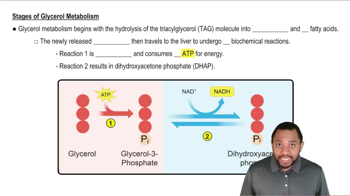
The glycerol backbone is a three-carbon molecule that serves as the structural foundation for various lipids, including triglycerides and phospholipids. In phospholipids, two of the hydroxyl groups of glycerol are esterified with fatty acids, while the third is linked to a phosphate group, which can further bond to other molecules like ethanolamine, contributing to the lipid's identity and function.
추천 영상:
가이드 코스
1:20
Glycerol Metabolism Concept 2