Ch.24 Lipid Metabolism
McMurry - Fundamentals of General, Organic, and Biological Chemistry 8th Edition
McMurry8th EditionFundamentals of General, Organic, and Biological ChemistryISBN: 9780134015187당신이 사용하는 게 아니라요?교과서 변경
24장, 문제 45

Arrange these following four molecules in increasing order of their biological energy content (per mole):
a. Sucrose
b. Myristic acid, CH3(CH2)12COOH
c. Glucose
d. Capric acid, CH3(CH2)8COOH

검증된 단계별 안내
1
Step 1: Understand the problem. The task is to arrange the given molecules (sucrose, myristic acid, glucose, and capric acid) in increasing order of their biological energy content per mole. Biological energy content is typically related to the number of high-energy bonds (e.g., C-H and C-C bonds) and the molecule's oxidation state.
Step 2: Analyze the structure of each molecule. Sucrose and glucose are carbohydrates, while myristic acid and capric acid are fatty acids. Fatty acids generally have more C-H bonds and are less oxidized compared to carbohydrates, meaning they typically have higher biological energy content.
Step 3: Compare the fatty acids. Myristic acid (CH₃(CH₂)₁₂COOH) has a longer hydrocarbon chain than capric acid (CH₃(CH₂)₈COOH), which means it has more C-H bonds and thus more biological energy content.
Step 4: Compare the carbohydrates. Sucrose is a disaccharide (composed of two monosaccharides) and has more bonds than glucose, a monosaccharide. However, carbohydrates are generally more oxidized than fatty acids, so their energy content is lower than that of fatty acids.
Step 5: Arrange the molecules in increasing order of biological energy content. Based on the analysis, glucose (most oxidized carbohydrate) has the least energy, followed by sucrose, then capric acid, and finally myristic acid (longest fatty acid chain with the most energy).

비슷한 문제에 대한 검증된 영상 답변:

이 영상 해법은 위 문제에 도움이 된다고 튜터들이 추천한 것입니다.
영상 길이:
2m
도움이 되었나요?

주요 개념

질문에 올바르게 답하기 위해 반드시 이해해야 하는 핵심 개념들은 다음과 같습니다.

Biological Energy Content

Biological energy content refers to the amount of energy that can be derived from a molecule when it is metabolized by living organisms. This energy is often measured in kilojoules or calories per mole and is influenced by the molecular structure, including the number of carbon and hydrogen atoms, which are key sources of energy in biological systems.
추천 영상:
가이드 코스
01:26
Nature of Energy

Fatty Acids vs. Carbohydrates

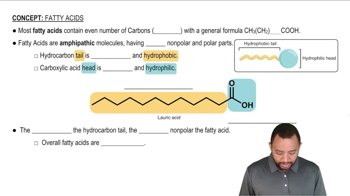
Fatty acids, such as myristic and capric acid, typically have higher energy content per mole compared to carbohydrates like glucose and sucrose. This is due to their longer hydrocarbon chains, which provide more carbon-hydrogen bonds that can be oxidized to release energy. Understanding the differences in energy storage between these two types of molecules is crucial for arranging them by energy content.
추천 영상:
가이드 코스
2:00
Fatty Acids Concept 1

Molecular Structure and Energy Release

The molecular structure of a compound significantly affects its energy release during metabolism. For instance, the presence of multiple carbon-carbon and carbon-hydrogen bonds in fatty acids allows for greater energy release compared to simpler structures like glucose or sucrose. Analyzing the structural features of each molecule helps in determining their relative energy content.
추천 영상: