Ch.24 Lipid Metabolism
McMurry - Fundamentals of General, Organic, and Biological Chemistry 8th Edition
McMurry8th EditionFundamentals of General, Organic, and Biological ChemistryISBN: 9780134015187당신이 사용하는 게 아니라요?교과서 변경
24장, 문제 48

Write the equation for the final step in the catabolism of any fatty acid with an even number of carbons.

검증된 단계별 안내
1
Identify the process involved: The final step in the catabolism of a fatty acid with an even number of carbons occurs during β-oxidation, where a two-carbon acetyl-CoA molecule is cleaved from the fatty acid chain.
Write the general structure of the fatty acid undergoing β-oxidation: A fatty acyl-CoA molecule with an even number of carbons, represented as CH₃-(CH₂)n-CO-SCoA, where n is an even integer.
Describe the reaction: In the final step of β-oxidation, the fatty acyl-CoA is cleaved by the enzyme thiolase, using a molecule of Coenzyme A (CoA-SH) to produce one acetyl-CoA (CH₃-CO-SCoA) and a shorter fatty acyl-CoA (if applicable).
Write the chemical equation for the reaction: CH₃-(CH₂)n-CO-SCoA + CoA-SH → CH₃-CO-SCoA + CH₃-(CH₂)n-2-CO-SCoA. Note that if n = 2, the reaction produces two acetyl-CoA molecules instead of a shorter fatty acyl-CoA.
Explain the significance: This step is crucial because acetyl-CoA enters the citric acid cycle (Krebs cycle) for further energy production, and the process repeats until the entire fatty acid is converted into acetyl-CoA units.

비슷한 문제에 대한 검증된 영상 답변:

이 영상 해법은 위 문제에 도움이 된다고 튜터들이 추천한 것입니다.
영상 길이:
3m

주요 개념

질문에 올바르게 답하기 위해 반드시 이해해야 하는 핵심 개념들은 다음과 같습니다.

Fatty Acid Catabolism

Fatty acid catabolism refers to the metabolic process by which fatty acids are broken down to produce energy. This process primarily occurs in the mitochondria and involves several steps, including activation, beta-oxidation, and the citric acid cycle. The end products of fatty acid catabolism are acetyl-CoA, which can enter the citric acid cycle, and reduced cofactors like NADH and FADH2, which are used in the electron transport chain.
추천 영상:
가이드 코스
2:00
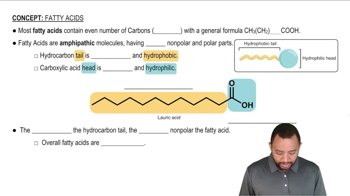
Fatty Acids Concept 1

Beta-Oxidation

Beta-oxidation is the key metabolic pathway for the breakdown of fatty acids. It involves the sequential removal of two-carbon units from the fatty acid chain, converting them into acetyl-CoA. Each cycle of beta-oxidation produces one molecule of acetyl-CoA, along with NADH and FADH2, which are crucial for ATP production in aerobic respiration. This process continues until the entire fatty acid is converted into acetyl-CoA units.
추천 영상:
가이드 코스
02:32
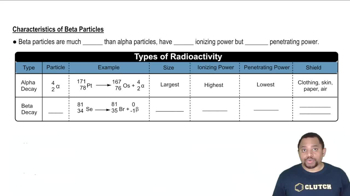
Characteristics of Beta Particles

Final Step of Fatty Acid Catabolism

The final step in the catabolism of an even-numbered fatty acid involves the conversion of the last two-carbon fragment into acetyl-CoA. This occurs after multiple rounds of beta-oxidation, where the fatty acid is progressively shortened. The equation for this final step can be represented as: CnH2nO2 + CoA → n/2 Acetyl-CoA, where 'n' is the number of carbons in the original fatty acid. This acetyl-CoA can then enter the citric acid cycle for further energy production.
추천 영상:
가이드 코스
1:06
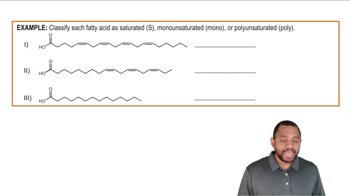
Fatty Acids Example 2