A low-fat diet of pasta, bread, beer, and soda can easily lead to an increase in weight. The increase is stored triacylglycerols in adipocytes. Explain the weight increase and why the excess carbohydrate is stored as fat.
Ch.24 Lipid Metabolism
McMurry8th EditionFundamentals of General, Organic, and Biological ChemistryISBN: 9780134015187당신이 사용하는 게 아니라요?교과서 변경
24장, 문제 68
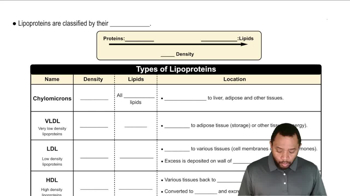
Lipoproteins that transport lipids from the diet are described as exogenous. Those that transport lipids produced in metabolic pathways are described as endogenous. Which of the following lipoproteins transports exogenous lipids and which transports endogenous lipids?
a. Low-density lipoprotein (LDL)
b. Chylomicrons
검증된 단계별 안내1
Understand the key terms: Exogenous lipids are those obtained from the diet, while endogenous lipids are those synthesized within the body through metabolic pathways.
Recall the function of chylomicrons: Chylomicrons are lipoproteins that transport dietary (exogenous) lipids, such as triglycerides, from the intestines to other tissues in the body.
Recall the function of low-density lipoprotein (LDL): LDL is a lipoprotein that primarily transports cholesterol, which is synthesized in the liver (endogenous), to peripheral tissues.
Classify chylomicrons: Based on their role in transporting dietary lipids, chylomicrons are responsible for transporting exogenous lipids.
Classify LDL: Based on its role in transporting cholesterol produced in the body, LDL is responsible for transporting endogenous lipids.

비슷한 문제에 대한 검증된 영상 답변:
이 영상 해법은 위 문제에 도움이 된다고 튜터들이 추천한 것입니다.
영상 길이:
3m도움이 되었나요?
주요 개념
질문에 올바르게 답하기 위해 반드시 이해해야 하는 핵심 개념들은 다음과 같습니다.
Lipoproteins
Lipoproteins are complex particles composed of lipids and proteins that transport fats through the bloodstream. They vary in density and function, with different types responsible for carrying either dietary lipids (exogenous) or lipids synthesized by the body (endogenous). Understanding the role of lipoproteins is crucial for grasping how lipids are distributed and utilized in the body.
추천 영상:
가이드 코스
Lipoproteins for Transport Concept 2
Exogenous vs. Endogenous Lipids
Exogenous lipids are those derived from dietary sources, primarily transported by chylomicrons, which are formed in the intestines after fat consumption. In contrast, endogenous lipids are produced by the liver and transported by lipoproteins such as low-density lipoprotein (LDL). This distinction is essential for understanding lipid metabolism and the implications for health and disease.
추천 영상:
가이드 코스
Intro to Lipids Example 1
Chylomicrons and LDL
Chylomicrons are a type of lipoprotein that specifically transport dietary lipids from the intestines to other tissues, making them key players in the exogenous lipid transport pathway. Low-density lipoprotein (LDL), on the other hand, is primarily responsible for carrying cholesterol and other lipids from the liver to peripheral tissues, representing the endogenous lipid transport pathway. Recognizing the functions of these lipoproteins helps in understanding their roles in cardiovascular health.
추천 영상:
가이드 코스
Lipoproteins for Transport Concept 2
관련 실천
교과서 질문
714
views
교과서 질문
Consuming too many carbohydrates causes deposition of fats in adipose tissue. How does this happen?
616
views
교과서 질문
Why are extra calories consumed as carbohydrates stored as fat and not as glycogen?
1025
views
교과서 질문
How many rounds of the lipogenesis cycle are needed to synthesize stearic acid, C17H35COOH?
697
views
교과서 질문
High blood-cholesterol levels are dangerous because of their correlation with atherosclerosis and consequent heart attacks and strokes. Is it possible to eliminate all cholesterol from the bloodstream by having a diet that includes no cholesterol? Is it desirable to have no cholesterol at all in your body? Explain your answer.
622
views