Ch.26 Nucleic Acids and Protein Synthesis
McMurry - Fundamentals of General, Organic, and Biological Chemistry 8th Edition
McMurry8th EditionFundamentals of General, Organic, and Biological ChemistryISBN: 9780134015187당신이 사용하는 게 아니라요?교과서 변경
26장, 문제 42a

What is meant by the term base pairing?

검증된 단계별 안내
1
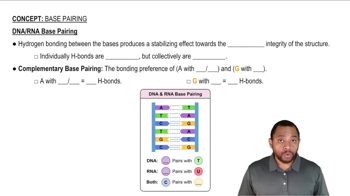
Base pairing refers to the specific hydrogen bonding between complementary nitrogenous bases in nucleic acids, such as DNA and RNA.
In DNA, the base pairing follows Chargaff's rules, where adenine (A) pairs with thymine (T) through two hydrogen bonds, and cytosine (C) pairs with guanine (G) through three hydrogen bonds.
In RNA, the base pairing is slightly different because thymine (T) is replaced by uracil (U). Therefore, adenine (A) pairs with uracil (U) in RNA, while cytosine (C) still pairs with guanine (G).
Base pairing is crucial for the double-helix structure of DNA, as it ensures the strands are complementary and allows for accurate replication and transcription processes.
The specificity of base pairing is due to the size, shape, and hydrogen bonding capabilities of the nitrogenous bases, ensuring stability and fidelity in genetic information storage and transfer.

비슷한 문제에 대한 검증된 영상 답변:

이 영상 해법은 위 문제에 도움이 된다고 튜터들이 추천한 것입니다.
영상 길이:
4m
도움이 되었나요?

주요 개념

질문에 올바르게 답하기 위해 반드시 이해해야 하는 핵심 개념들은 다음과 같습니다.

Base Pairing

Base pairing refers to the specific hydrogen bonding between nucleotide bases in DNA and RNA. In DNA, adenine pairs with thymine (A-T) and cytosine pairs with guanine (C-G), while in RNA, adenine pairs with uracil (A-U). This complementary pairing is crucial for the structure of nucleic acids and ensures accurate replication and transcription of genetic information.
추천 영상:
가이드 코스
2:56
Base Pairing Concept 1

Nucleotide Structure

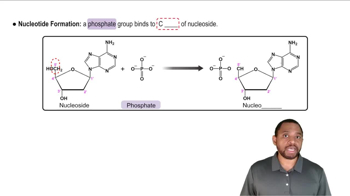
Nucleotides are the building blocks of nucleic acids, consisting of a sugar, a phosphate group, and a nitrogenous base. The sequence of these bases encodes genetic information, and their arrangement determines the specific base pairing that occurs. Understanding nucleotide structure is essential for grasping how base pairing functions in the context of DNA and RNA.
추천 영상:
가이드 코스
1:19
Nucleoside and Nucleotide Formation Concept 2

Complementarity

Complementarity is the principle that explains how specific base pairs align with one another due to their unique shapes and chemical properties. This concept is fundamental to the stability of the DNA double helix and the accurate pairing during DNA replication and RNA synthesis. It ensures that genetic information is preserved and correctly expressed in living organisms.
추천 영상:
가이드 코스
2:23
Types of RNA Concept 2