Ch.26 Nucleic Acids and Protein Synthesis
McMurry - Fundamentals of General, Organic, and Biological Chemistry 8th Edition
McMurry8th EditionFundamentals of General, Organic, and Biological ChemistryISBN: 9780134015187당신이 사용하는 게 아니라요?교과서 변경
26장, 문제 46

If a double-stranded DNA molecule is 22% G, what is the percentage of A, T, and C? Explain.

검증된 단계별 안내
1
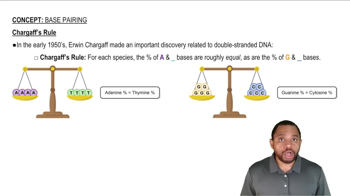
Step 1: Recall Chargaff's rules, which state that in double-stranded DNA, the amount of guanine (G) is equal to the amount of cytosine (C), and the amount of adenine (A) is equal to the amount of thymine (T). This means G = C and A = T.
Step 2: Since the DNA molecule is 22% guanine (G), the percentage of cytosine (C) must also be 22%. Therefore, the combined percentage of G and C is 22% + 22% = 44%.
Step 3: The total percentage of all four bases (A, T, G, C) in DNA must equal 100%. Subtract the combined percentage of G and C from 100% to find the combined percentage of A and T: 100% - 44% = 56%.
Step 4: Since adenine (A) and thymine (T) are present in equal amounts (A = T), divide the combined percentage of A and T equally between A and T: 56% ÷ 2 = 28%.
Step 5: Summarize the percentages: Guanine (G) = 22%, Cytosine (C) = 22%, Adenine (A) = 28%, Thymine (T) = 28%.

비슷한 문제에 대한 검증된 영상 답변:

이 영상 해법은 위 문제에 도움이 된다고 튜터들이 추천한 것입니다.
영상 길이:
3m
도움이 되었나요?

주요 개념

질문에 올바르게 답하기 위해 반드시 이해해야 하는 핵심 개념들은 다음과 같습니다.

Base Pairing Rules

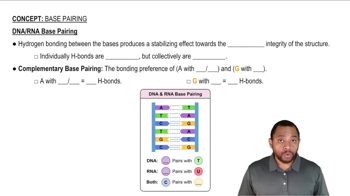
In DNA, the base pairing rules dictate that guanine (G) pairs with cytosine (C), and adenine (A) pairs with thymine (T). This means that the amount of G in a double-stranded DNA molecule is equal to the amount of C, and the amount of A is equal to the amount of T. Understanding these rules is essential for calculating the percentages of the other bases when one is known.
추천 영상:
가이드 코스
2:01
Base Pairing Concept 2

Complementary Base Composition

The complementary nature of DNA bases leads to a specific relationship in their proportions. If a double-stranded DNA molecule has a certain percentage of one base, the percentages of its complementary base and the other two bases can be derived. For example, knowing that G is 22% allows us to conclude that C is also 22%, which helps in determining the percentages of A and T.
추천 영상:
가이드 코스
2:56
Base Pairing Concept 1

Total Percentage of Bases

In a double-stranded DNA molecule, the total percentage of all four bases (A, T, G, C) must equal 100%. This means that once the percentages of G and C are established, the remaining percentage can be divided equally between A and T. This concept is crucial for solving the problem, as it allows for the calculation of the unknown base percentages based on the known values.
추천 영상:
가이드 코스
2:48
Total Energy From Glucose Concept 2