Ch. 1 - Remembering General Chemistry: Electronic Structure and Bonding
Bruice - Organic Chemistry 8th Edition
Bruice8th EditionOrganic ChemistryISBN: 9780135213711당신이 사용하는 게 아니라요?교과서 변경
1장, 문제 38(3)

a. Which bond would be longer?
b. Which bond would be stronger?
3. H—Cl or H—F

검증된 단계별 안내
1
Step 1: Understand the relationship between bond length and bond strength. Bond length is the distance between the nuclei of two bonded atoms, and bond strength is the energy required to break the bond. Generally, shorter bonds are stronger because the atoms are held more tightly together.
Step 2: Analyze the atomic sizes of the elements involved. Chlorine (Cl) is larger in size compared to Fluorine (F) because it is located further down the periodic table. Larger atoms form longer bonds due to the increased distance between their nuclei.
Step 3: Compare the bond lengths of H—Cl and H—F. Since Cl is larger than F, the H—Cl bond will be longer than the H—F bond.
Step 4: Compare the bond strengths of H—Cl and H—F. The H—F bond is shorter, and shorter bonds are generally stronger. Therefore, the H—F bond will be stronger than the H—Cl bond.
Step 5: Summarize the findings: The H—Cl bond is longer, while the H—F bond is stronger. This is due to the differences in atomic size and the inverse relationship between bond length and bond strength.

비슷한 문제에 대한 검증된 영상 답변:

이 영상 해법은 위 문제에 도움이 된다고 튜터들이 추천한 것입니다.
영상 길이:
2m
도움이 되었나요?

주요 개념

질문에 올바르게 답하기 위해 반드시 이해해야 하는 핵심 개념들은 다음과 같습니다.

Bond Length

Bond length refers to the distance between the nuclei of two bonded atoms. Generally, bond length is influenced by the size of the atoms involved and the type of bond (single, double, or triple). Larger atoms tend to form longer bonds due to increased distance between their nuclei. In the case of H—Cl and H—F, the bond length can be compared based on the atomic sizes of chlorine and fluorine.
추천 영상:
가이드 코스
06:00
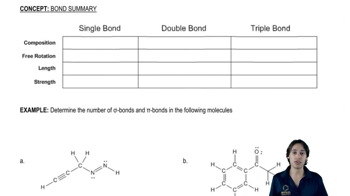
Single bonds, double bonds, and triple bonds.

Bond Strength

Bond strength, or bond dissociation energy, is the energy required to break a bond between two atoms. Stronger bonds have higher bond dissociation energies. Factors affecting bond strength include the type of bond, the electronegativity of the atoms, and the presence of lone pairs. In comparing H—Cl and H—F, the bond strength can be assessed by considering the electronegativity differences and the resulting bond characteristics.
추천 영상:
가이드 코스
06:00
Single bonds, double bonds, and triple bonds.

Electronegativity

Electronegativity is a measure of an atom's ability to attract and hold onto electrons in a bond. It plays a crucial role in determining bond polarity and strength. Fluorine is the most electronegative element, which means it pulls electron density towards itself more than chlorine does. This difference in electronegativity between H—Cl and H—F affects both the bond length and strength, with H—F being shorter and stronger due to the higher electronegativity of fluorine.
추천 영상:
가이드 코스
1:47
Electronegativity