Ch. 1 - Remembering General Chemistry: Electronic Structure and Bonding
Bruice - Organic Chemistry 8th Edition
Bruice8th EditionOrganic ChemistryISBN: 9780135213711당신이 사용하는 게 아니라요?교과서 변경
1장, 문제 26a,b

Indicate the kind of molecular orbital (σσ*π, or π*) that results when the two atomic orbitals are combined:
a. <IMAGE>
b. <IMAGE>

검증된 단계별 안내
1
Step 1: Analyze the image labeled 'A'. The two atomic orbitals are overlapping end-to-end along the internuclear axis. This type of overlap typically results in the formation of a sigma (σ) molecular orbital.
Step 2: Consider the bonding interaction in 'A'. Since the lobes of the orbitals are overlapping constructively (same phase), this indicates the formation of a bonding sigma (σ) orbital.
Step 3: Analyze the image labeled 'B'. The two atomic orbitals are overlapping end-to-end along the internuclear axis, but the lobes are overlapping destructively (opposite phases). This type of interaction results in the formation of an antibonding sigma star (σ*) molecular orbital.
Step 4: Understand the concept of molecular orbitals. Sigma (σ) orbitals are formed by constructive overlap of atomic orbitals along the internuclear axis, while sigma star (σ*) orbitals are formed by destructive overlap.
Step 5: Summarize the results: 'A' corresponds to a bonding sigma (σ) orbital, and 'B' corresponds to an antibonding sigma star (σ*) orbital.

비슷한 문제에 대한 검증된 영상 답변:

이 영상 해법은 위 문제에 도움이 된다고 튜터들이 추천한 것입니다.
영상 길이:
3m
도움이 되었나요?

주요 개념

질문에 올바르게 답하기 위해 반드시 이해해야 하는 핵심 개념들은 다음과 같습니다.

Molecular Orbitals

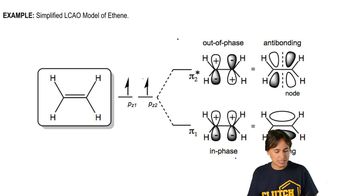
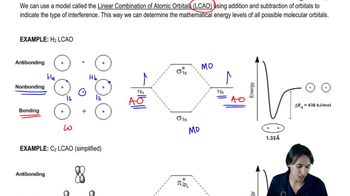
Molecular orbitals (MOs) are formed when atomic orbitals combine during the bonding process. They can be classified into bonding and antibonding orbitals. Bonding orbitals, such as σ and π, stabilize the molecule, while antibonding orbitals, like σ* and π*, destabilize it. Understanding the shapes and orientations of these orbitals is crucial for predicting molecular behavior.
추천 영상:
08:41
Review of Molecular Orbitals

Bonding and Antibonding Orbitals

Bonding orbitals (σ and π) result from the constructive interference of atomic orbitals, leading to increased electron density between nuclei, which stabilizes the molecule. Antibonding orbitals (σ* and π*) arise from destructive interference, resulting in decreased electron density between nuclei and increased energy. Identifying whether the combination of atomic orbitals leads to bonding or antibonding orbitals is essential for understanding molecular stability.
추천 영상:
11:25
What’s the difference between atomic and molecular orbitals?

Orbital Symmetry and Orientation

The symmetry and orientation of atomic orbitals play a critical role in determining the type of molecular orbital formed. For example, the overlap of two p orbitals can create π or π* orbitals depending on their relative orientation. Recognizing how the shapes of orbitals interact helps predict the resulting molecular orbital type, which is key to answering the question posed.
추천 영상:
00:25
Determining Chirality with Plane of Symmetry