Ch. 1 - Remembering General Chemistry: Electronic Structure and Bonding
Bruice - Organic Chemistry 8th Edition
Bruice8th EditionOrganic ChemistryISBN: 9780135213711당신이 사용하는 게 아니라요?교과서 변경
1장, 문제 23

Convert the models in Problem 20 to skeletal structures.
a. <IMAGE>
b. <IMAGE>
c. <IMAGE>
d. <IMAGE>

검증된 단계별 안내
1
Step 1: Analyze the first model (image a). Identify the atoms and bonds. The structure contains two carbon atoms bonded together, with one carbon attached to three hydrogens and the other bonded to two hydrogens and a chlorine atom. Convert this to a skeletal structure by representing the carbon-carbon bond as a line and omitting hydrogen atoms bonded to carbons.
Step 2: Examine the second model (image b). This structure includes a carbonyl group (C=O) attached to a carbon atom, which is bonded to another carbon atom. The second carbon is bonded to three hydrogens. Convert this to a skeletal structure by representing the carbon-carbon bonds as lines and showing the carbonyl group explicitly.
Step 3: Analyze the third model (image c). This structure contains a carbonyl group (C=O) attached to a carbon atom, which is bonded to a nitrogen atom. The nitrogen atom is bonded to another carbon atom, which is connected to two methyl groups. Convert this to a skeletal structure by representing the carbon-carbon and carbon-nitrogen bonds as lines, showing the carbonyl group explicitly, and representing the methyl groups as branches.
Step 4: Examine the fourth model (image d). This structure contains a triple bond between a carbon and a nitrogen atom. The carbon is bonded to another carbon atom, which is bonded to three hydrogens. Convert this to a skeletal structure by representing the carbon-carbon bond as a line and the carbon-nitrogen triple bond explicitly.
Step 5: Ensure all skeletal structures are drawn correctly by verifying the number of bonds around each atom matches its valency (e.g., carbon forms four bonds, nitrogen forms three bonds, etc.). Double-check that hydrogens are omitted in the skeletal structure unless attached to heteroatoms like oxygen or nitrogen.

비슷한 문제에 대한 검증된 영상 답변:

이 영상 해법은 위 문제에 도움이 된다고 튜터들이 추천한 것입니다.
영상 길이:
4m
도움이 되었나요?

주요 개념

질문에 올바르게 답하기 위해 반드시 이해해야 하는 핵심 개념들은 다음과 같습니다.

Skeletal Structures

Skeletal structures are simplified representations of organic molecules that depict only the carbon backbone and functional groups. In these diagrams, carbon atoms are represented by vertices or ends of lines, while hydrogen atoms attached to carbons are usually omitted for clarity. This method allows chemists to quickly visualize the molecular framework and identify functional groups without the clutter of hydrogen atoms.
추천 영상:
가이드 코스
04:03
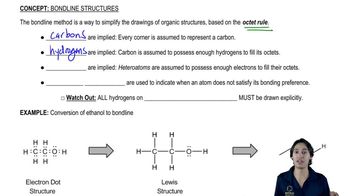
How bondline is different from Lewis Structures.

Functional Groups

Functional groups are specific groups of atoms within molecules that are responsible for the characteristic chemical reactions of those molecules. They determine the properties and reactivity of organic compounds. Common functional groups include hydroxyl (-OH), carboxyl (-COOH), and amine (-NH2), and recognizing them is crucial for understanding the behavior of organic molecules in chemical reactions.
추천 영상:
가이드 코스
02:36
Identifying Functional Groups

Bonding and Hybridization

Bonding and hybridization are fundamental concepts in organic chemistry that describe how atoms connect to form molecules. Hybridization involves the mixing of atomic orbitals to create new hybrid orbitals, which can form sigma bonds with other atoms. Understanding the types of bonds (single, double, triple) and the geometry of hybridized orbitals is essential for predicting molecular shapes and reactivity.
추천 영상:
가이드 코스
10:43
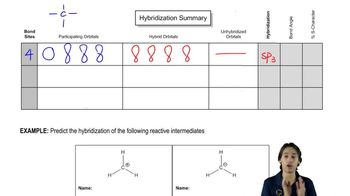
Using bond sites to predict hybridization