Ch. 10 - Reactions of Alcohols, Ethers, Epoxides, Amines, and Sulfur-Containing Compounds
Bruice - Organic Chemistry 8th Edition
Bruice8th EditionOrganic ChemistryISBN: 9780135213711당신이 사용하는 게 아니라요?교과서 변경
10장, 문제 5a

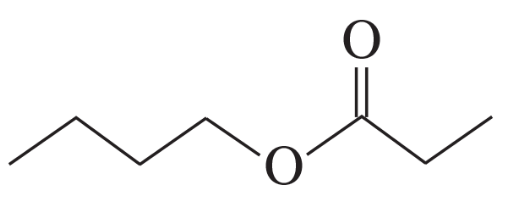
Explain how 1-butanol can be converted into the following compounds:
a.

검증된 단계별 안내
1
Step 1: Recognize that the target compound is an ester, specifically ethyl butanoate. Esters are typically formed through a reaction between a carboxylic acid and an alcohol in the presence of an acid catalyst.
Step 2: Convert 1-butanol into butanoic acid. This can be achieved by oxidizing 1-butanol using an oxidizing agent such as potassium dichromate (K₂Cr₂O₇) in acidic conditions (H₂SO₄). The primary alcohol is oxidized to a carboxylic acid.
Step 3: Prepare ethanol, which will act as the alcohol component in the esterification reaction. Ethanol is readily available and does not require synthesis in this case.
Step 4: Perform the esterification reaction. Mix butanoic acid and ethanol in the presence of a strong acid catalyst, such as concentrated sulfuric acid (H₂SO₄). Heat the mixture to promote the reaction, which forms ethyl butanoate and water as byproducts.
Step 5: Purify the ester product. Use techniques such as distillation to separate ethyl butanoate from the reaction mixture, ensuring the removal of unreacted starting materials and byproducts.

비슷한 문제에 대한 검증된 영상 답변:

이 영상 해법은 위 문제에 도움이 된다고 튜터들이 추천한 것입니다.
영상 길이:
1m

주요 개념

질문에 올바르게 답하기 위해 반드시 이해해야 하는 핵심 개념들은 다음과 같습니다.

Alcohol Functional Group

1-butanol is a primary alcohol, characterized by the presence of a hydroxyl (-OH) group attached to a carbon chain. Understanding the properties of alcohols, including their reactivity and ability to undergo various chemical transformations, is essential for predicting how 1-butanol can be converted into other compounds.
추천 영상:
02:36
Identifying Functional Groups

Oxidation Reactions

Oxidation reactions involve the loss of electrons or an increase in oxidation state, often converting alcohols into aldehydes, ketones, or carboxylic acids. For 1-butanol, oxidation can lead to the formation of butanal or butanoic acid, depending on the reaction conditions and reagents used.
추천 영상:
03:20
Benzylic Oxidation

Substitution Reactions

Substitution reactions occur when an atom or group in a molecule is replaced by another atom or group. In the case of 1-butanol, it can undergo substitution to form alkyl halides through reactions with halogenating agents, which is crucial for synthesizing various organic compounds from the alcohol.
추천 영상:
01:34
Recognizing Substitution Reactions.