Ch. 10 - Reactions of Alcohols, Ethers, Epoxides, Amines, and Sulfur-Containing Compounds
Bruice - Organic Chemistry 8th Edition
Bruice8th EditionOrganic ChemistryISBN: 9780135213711당신이 사용하는 게 아니라요?교과서 변경
10장, 문제 3

Explain the difference in reactivity between CH3O+H2 and CH3OH in a nucleophilic substitution reaction. (The pKa of H3O+ is −1.7.)

검증된 단계별 안내
1
Step 1: Understand the nature of the species involved. CH3O+H2 is a protonated methanol molecule, where the oxygen atom carries a positive charge due to the addition of a proton (H+). CH3OH, on the other hand, is neutral methanol, where the oxygen atom has lone pairs of electrons and no formal charge.
Step 2: Analyze the stability of the species. The protonated methanol (CH3O+H2) is less stable because the positive charge on the oxygen atom creates significant electron deficiency. This makes it more reactive compared to neutral methanol (CH3OH), which is more stable due to the absence of a formal charge.
Step 3: Consider the leaving group ability. In a nucleophilic substitution reaction, the leaving group plays a critical role. When CH3O+H2 reacts, it can lose a water molecule (H2O) as the leaving group. Water is a very good leaving group because it is neutral and stable. In contrast, CH3OH does not have a good leaving group unless it is first protonated to form CH3O+H2.
Step 4: Relate the pKa values to reactivity. The pKa of H3O+ is −1.7, indicating that it is a very strong acid. This means that the conjugate base (H2O) is very stable. The protonation of CH3OH to form CH3O+H2 increases the reactivity of the molecule in a nucleophilic substitution reaction because it facilitates the formation of a stable leaving group (H2O).
Step 5: Conclude the difference in reactivity. CH3O+H2 is more reactive in a nucleophilic substitution reaction compared to CH3OH because the protonation of CH3OH enhances the leaving group ability by forming water (H2O), a stable and neutral molecule. Neutral CH3OH lacks this enhanced leaving group ability unless it is first protonated.

비슷한 문제에 대한 검증된 영상 답변:

이 영상 해법은 위 문제에 도움이 된다고 튜터들이 추천한 것입니다.
영상 길이:
2m
도움이 되었나요?

주요 개념

질문에 올바르게 답하기 위해 반드시 이해해야 하는 핵심 개념들은 다음과 같습니다.

Nucleophilic Substitution Reactions

Nucleophilic substitution reactions involve the replacement of a leaving group in a molecule by a nucleophile. The nucleophile donates a pair of electrons to form a new bond, while the leaving group departs with its electrons. Understanding the mechanism (either SN1 or SN2) is crucial, as it influences the reactivity and the rate of the reaction based on sterics and the nature of the nucleophile.
추천 영상:
01:47
Nucleophiles and Electrophiles can react in Substitution Reactions.

Acidity and pKa

The pKa value indicates the strength of an acid; lower pKa values correspond to stronger acids. In this context, H3O+ (with a pKa of -1.7) is a very strong acid, which means it can readily donate protons. The acidity of a compound affects its reactivity in nucleophilic substitution, as stronger acids can stabilize the transition state and influence the nucleophile's ability to attack.
추천 영상:
07:45
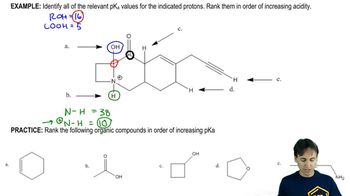
Identifying pKa values

Stability of Carbocations

Carbocations are positively charged carbon species that play a key role in many nucleophilic substitution reactions, particularly in the SN1 mechanism. The stability of a carbocation is influenced by factors such as the degree of substitution (tertiary > secondary > primary) and resonance. A more stable carbocation will form more readily, affecting the overall reactivity of the substrate in the reaction.
추천 영상:
05:58
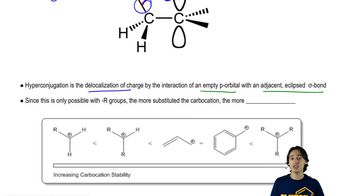
Determining Carbocation Stability