Ch. 10 - Reactions of Alcohols, Ethers, Epoxides, Amines, and Sulfur-Containing Compounds
Bruice - Organic Chemistry 8th Edition
Bruice8th EditionOrganic ChemistryISBN: 9780135213711당신이 사용하는 게 아니라요?교과서 변경
10장, 문제 86

Propose a mechanism for the following reaction:

검증된 단계별 안내
1
Step 1: Recognize the reaction type. This is an acid-catalyzed dehydration of an alcohol, where the hydroxyl group (-OH) is removed, and a double bond is formed in the product. The catalyst is sulfuric acid (H₂SO₄), and heat is applied to drive the reaction forward.
Step 2: Protonation of the alcohol group. The sulfuric acid donates a proton (H⁺) to the hydroxyl group (-OH) of the alcohol, converting it into a better leaving group, water (H₂O). The structure now contains a positively charged oxonium ion.
Step 3: Formation of the carbocation intermediate. The water molecule leaves, resulting in the formation of a carbocation at the carbon where the hydroxyl group was originally attached. This is the rate-determining step of the reaction.
Step 4: Rearrangement of the carbocation (if necessary). In this case, no rearrangement is needed because the carbocation is already on a secondary carbon, which is relatively stable.
Step 5: Elimination to form the alkene. A proton is removed from a neighboring carbon atom by a base (often HSO₄⁻ from the sulfuric acid), leading to the formation of a double bond between the carbons. This results in the final alkene product and regenerates the acid catalyst.

비슷한 문제에 대한 검증된 영상 답변:

이 영상 해법은 위 문제에 도움이 된다고 튜터들이 추천한 것입니다.

주요 개념

질문에 올바르게 답하기 위해 반드시 이해해야 하는 핵심 개념들은 다음과 같습니다.

Reaction Mechanism

A reaction mechanism is a step-by-step description of how a chemical reaction occurs at the molecular level. It outlines the sequence of elementary steps, including bond breaking and formation, and the intermediates formed during the reaction. Understanding the mechanism is crucial for predicting the products and the conditions under which the reaction occurs.
추천 영상:
02:16
Heck Reaction Mechanism

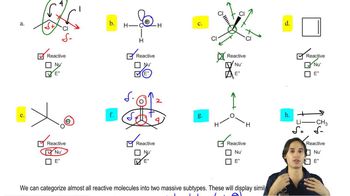
Nucleophiles and Electrophiles

Nucleophiles are species that donate an electron pair to form a chemical bond, while electrophiles are electron-deficient species that accept an electron pair. Identifying these species in a reaction is essential for proposing a mechanism, as it helps to determine the flow of electrons and the formation of new bonds during the reaction.
추천 영상:
03:
Nucleophile or Electrophile

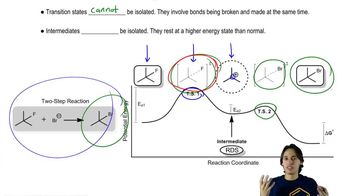
Transition States and Intermediates

Transition states are high-energy states that occur during the transformation from reactants to products, representing the point of maximum energy along the reaction pathway. Intermediates are species that are formed and consumed during the reaction but are not present in the final products. Understanding these concepts is vital for accurately depicting the mechanism and predicting the reaction's rate and outcome.
추천 영상:
06:55
Intermediates vs. Transition States