Ch. 10 - Reactions of Alcohols, Ethers, Epoxides, Amines, and Sulfur-Containing Compounds
Bruice - Organic Chemistry 8th Edition
Bruice8th EditionOrganic ChemistryISBN: 9780135213711당신이 사용하는 게 아니라요?교과서 변경
10장, 문제 50b

Using an alkyl halide and a thiol as starting materials, how would you prepare the following thioethers?
b.

검증된 단계별 안내
1
Step 1: Identify the target thioether structure. The given structure contains a sulfur atom bonded to a methyl group and a tert-butyl group. This indicates that the starting materials should include a thiol (R-SH) and an alkyl halide (R-X) that can form these groups.
Step 2: Select the thiol starting material. To introduce the methyl group bonded to sulfur, use methanethiol (CH₃SH) as the thiol starting material.
Step 3: Select the alkyl halide starting material. To introduce the tert-butyl group bonded to sulfur, use tert-butyl bromide (C(CH₃)₃Br) as the alkyl halide starting material.
Step 4: Perform the nucleophilic substitution reaction. The thiol (CH₃SH) acts as a nucleophile and attacks the alkyl halide (C(CH₃)₃Br) in an SN2 reaction mechanism, displacing the bromide ion and forming the thioether product.
Step 5: Ensure reaction conditions are suitable. Use a polar aprotic solvent (e.g., acetone or DMSO) to facilitate the SN2 reaction and maintain mild conditions to avoid side reactions.

비슷한 문제에 대한 검증된 영상 답변:

이 영상 해법은 위 문제에 도움이 된다고 튜터들이 추천한 것입니다.
영상 길이:
2m

주요 개념

질문에 올바르게 답하기 위해 반드시 이해해야 하는 핵심 개념들은 다음과 같습니다.

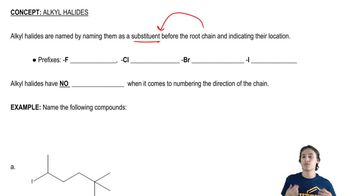
Alkyl Halides

Alkyl halides are organic compounds containing a carbon atom bonded to a halogen atom (such as chlorine, bromine, or iodine). They are key reactants in nucleophilic substitution reactions, where the halogen can be replaced by a nucleophile, such as a thiol, to form new compounds. Understanding the reactivity and structure of alkyl halides is essential for predicting the outcomes of reactions involving these molecules.
추천 영상:
01:52
How to name alkyl halides

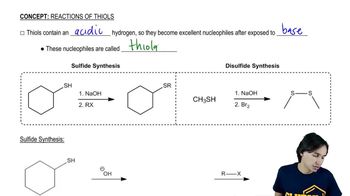
Thiol

Thiol compounds, also known as mercaptans, are characterized by the presence of a sulfhydryl group (-SH) attached to a carbon atom. They are nucleophilic in nature, meaning they can donate a pair of electrons to form a bond with electrophiles, such as alkyl halides. This property makes thiols valuable in the synthesis of thioethers through nucleophilic substitution reactions.
추천 영상:
03:21
The mechanism of Sulfide Synthesis.

Thioether Formation

Thioethers are organic compounds formed by the reaction of an alkyl halide with a thiol, resulting in the substitution of the halogen atom with the thiol's sulfur atom. This reaction typically occurs via an SN2 mechanism, where the nucleophile (thiol) attacks the electrophilic carbon of the alkyl halide, leading to the formation of a thioether and the release of a halide ion. Understanding this mechanism is crucial for successfully synthesizing thioethers.
추천 영상:
02:26
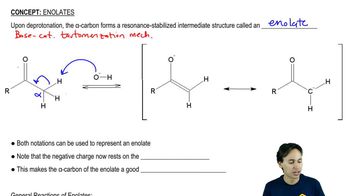
Formation of Enolates