Ch. 10 - Reactions of Alcohols, Ethers, Epoxides, Amines, and Sulfur-Containing Compounds
Bruice - Organic Chemistry 8th Edition
Bruice8th EditionOrganic ChemistryISBN: 9780135213711당신이 사용하는 게 아니라요?교과서 변경
10장, 문제 50a

Using an alkyl halide and a thiol as starting materials, how would you prepare the following thioethers?
a.

검증된 단계별 안내
1
Step 1: Recognize the target molecule as a thioether (sulfide), which has the general structure R-S-R'. In this case, both R and R' are ethyl groups (C2H5).
Step 2: Identify the starting materials. You need an alkyl halide and a thiol. For this synthesis, use ethyl bromide (C2H5Br) as the alkyl halide and ethanethiol (C2H5SH) as the thiol.
Step 3: Understand the reaction mechanism. This is a nucleophilic substitution reaction (SN2 mechanism). The thiol (C2H5SH) acts as a nucleophile, attacking the electrophilic carbon in the ethyl bromide (C2H5Br), displacing the bromide ion (Br⁻).
Step 4: Write the reaction equation: \( \text{C}_2\text{H}_5\text{SH} + \text{C}_2\text{H}_5\text{Br} \rightarrow \text{C}_2\text{H}_5\text{S}\text{C}_2\text{H}_5 + \text{HBr} \). This shows the formation of the thioether and hydrobromic acid as a byproduct.
Step 5: Ensure proper reaction conditions. Perform the reaction in a polar aprotic solvent (e.g., acetone or DMSO) to favor the SN2 mechanism. Use a mild base (e.g., NaOH or KOH) to deprotonate the thiol, increasing its nucleophilicity and facilitating the reaction.

비슷한 문제에 대한 검증된 영상 답변:

이 영상 해법은 위 문제에 도움이 된다고 튜터들이 추천한 것입니다.
영상 길이:
1m

주요 개념

질문에 올바르게 답하기 위해 반드시 이해해야 하는 핵심 개념들은 다음과 같습니다.

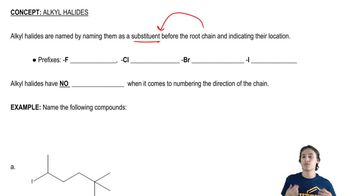
Alkyl Halides

Alkyl halides are organic compounds containing a carbon atom bonded to a halogen atom (such as chlorine, bromine, or iodine). They are key intermediates in organic synthesis and can undergo nucleophilic substitution reactions, where the halogen is replaced by a nucleophile, such as a thiol, to form new compounds like thioethers.
추천 영상:
01:52
How to name alkyl halides

Thiol Chemistry

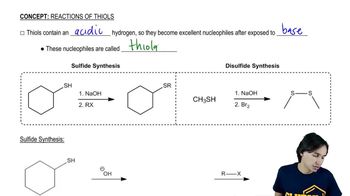
Thiols are organic compounds that contain a sulfhydryl group (-SH). They are nucleophilic in nature, meaning they can donate a pair of electrons to form a bond with electrophiles, such as alkyl halides. In the synthesis of thioethers, thiols react with alkyl halides through nucleophilic substitution, resulting in the formation of thioether linkages.
추천 영상:
03:21
The mechanism of Sulfide Synthesis.

Nucleophilic Substitution Mechanisms

Nucleophilic substitution is a fundamental reaction mechanism in organic chemistry where a nucleophile attacks an electrophile, leading to the replacement of a leaving group. There are two main types: SN1, which involves a two-step mechanism with carbocation formation, and SN2, which is a one-step process where the nucleophile attacks the electrophile simultaneously as the leaving group departs. Understanding these mechanisms is crucial for predicting the outcomes of reactions involving alkyl halides and thiols.
추천 영상:
01:47
Nucleophiles and Electrophiles can react in Substitution Reactions.