Ch. 12 - Radicals
Bruice - Organic Chemistry 8th Edition
Bruice8th EditionOrganic ChemistryISBN: 9780135213711당신이 사용하는 게 아니라요?교과서 변경
12장, 문제 19a

How many allylic substituted bromoalkenes are formed from the reactions in Problems 18 if stereoisomers are included?

검증된 단계별 안내
1
Step 1: Analyze the reaction conditions. The reaction involves NBS (N-bromosuccinimide) in the presence of heat (Δ) and peroxide. This is a typical setup for allylic bromination, where bromine is introduced at the allylic position of an alkene.
Step 2: Identify the allylic positions in the given molecule. The molecule is cyclopentene, which has two allylic positions (the carbons adjacent to the double bond). These positions are equivalent due to the symmetry of the molecule.
Step 3: Consider the stereochemistry of the bromination. Bromination at the allylic position can lead to the formation of stereoisomers because the bromine atom can be added to either side of the planar allylic radical intermediate.
Step 4: Determine the possible products. Since the allylic positions are equivalent, bromination at either position will yield the same set of products. However, the stereoisomers arise due to the different spatial arrangements of the bromine atom relative to the double bond.
Step 5: Count the number of stereoisomers. For each allylic position, two stereoisomers (E and Z configurations) can be formed due to the double bond geometry. Since the allylic positions are equivalent, the total number of allylic substituted bromoalkenes formed, including stereoisomers, is the sum of these possibilities.

비슷한 문제에 대한 검증된 영상 답변:

이 영상 해법은 위 문제에 도움이 된다고 튜터들이 추천한 것입니다.
영상 길이:
5m

주요 개념

질문에 올바르게 답하기 위해 반드시 이해해야 하는 핵심 개념들은 다음과 같습니다.

Allylic Bromination

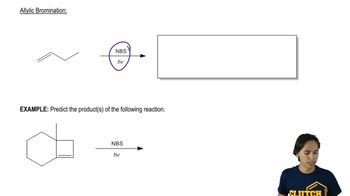
Allylic bromination is a reaction where bromine is added to the allylic position of an alkene, typically using N-bromosuccinimide (NBS) in the presence of a radical initiator like peroxide. This reaction proceeds via a radical mechanism, where the allylic hydrogen is abstracted, forming a resonance-stabilized radical that can then react with bromine to form bromoalkenes.
추천 영상:
00:54
Mechanism of Allylic Bromination.

Stereoisomerism

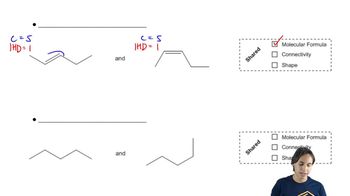
Stereoisomerism refers to the phenomenon where compounds have the same molecular formula and connectivity but differ in the spatial arrangement of atoms. In the context of allylic bromination, the formation of stereoisomers occurs due to the presence of chiral centers or double bonds, leading to different geometric configurations (cis/trans or E/Z) in the resulting bromoalkenes.
추천 영상:
01:58
Determining when molecules are stereoisomers.

Radical Mechanism

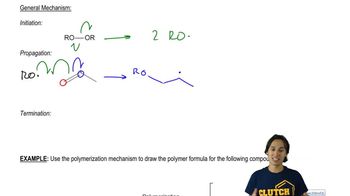
A radical mechanism involves the formation and reaction of free radicals, which are highly reactive species with unpaired electrons. In allylic bromination, the initiation step generates radicals that facilitate the bromination process. Understanding this mechanism is crucial for predicting the products and their stereochemistry, as radicals can lead to multiple pathways and product distributions.
추천 영상:
03:28
The mechanism of Radical Polymerization.