Ch. 12 - Radicals
Bruice - Organic Chemistry 8th Edition
Bruice8th EditionOrganic ChemistryISBN: 9780135213711당신이 사용하는 게 아니라요?교과서 변경
12장, 문제 19

How many allylic substituted bromoalkenes are formed from the reactions in Problems 17 if stereoisomers are included?

검증된 단계별 안내
1
Step 1: Analyze the given reaction conditions. The reaction involves NBS (N-bromosuccinimide) in the presence of heat (Δ) and peroxide. This is a radical bromination reaction that selectively brominates allylic positions in alkenes.
Step 2: Identify the allylic positions in the given molecule. Allylic positions are the carbon atoms adjacent to the double bond. In the provided structure, there are two allylic positions on either side of the double bond.
Step 3: Consider the possible products formed by bromination at each allylic position. Bromination at each allylic position can lead to different regioisomers, depending on which allylic hydrogen is replaced by bromine.
Step 4: Account for stereoisomers. Since the allylic carbons are sp3 hybridized, bromination can lead to stereoisomers (R and S configurations) at each brominated position. This increases the number of possible products.
Step 5: Combine regioisomeric and stereoisomeric possibilities. For each allylic position, consider the number of stereoisomers formed. Add these together to determine the total number of allylic substituted bromoalkenes formed.

비슷한 문제에 대한 검증된 영상 답변:

이 영상 해법은 위 문제에 도움이 된다고 튜터들이 추천한 것입니다.
영상 길이:
4m

주요 개념

질문에 올바르게 답하기 위해 반드시 이해해야 하는 핵심 개념들은 다음과 같습니다.

Allylic Substitution

Allylic substitution refers to the replacement of a hydrogen atom at the allylic position (the carbon adjacent to a double bond) with another atom or group. This reaction is significant in organic chemistry as it allows for the formation of new compounds with varied properties. The presence of a double bond influences the reactivity and stability of the intermediates formed during the reaction.
추천 영상:
00:48
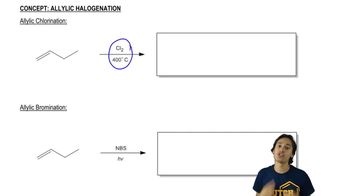
The products of Allylic Chlorination.

Bromination with NBS

N-Bromosuccinimide (NBS) is a reagent commonly used for allylic bromination. It generates bromine radicals under specific conditions, such as heat or light, which can abstract hydrogen atoms from the allylic position, leading to the formation of allylic bromides. This method is advantageous because it selectively brominates the allylic position while minimizing the formation of other byproducts.
추천 영상:
00:54
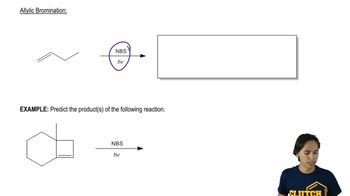
Mechanism of Allylic Bromination.

Stereoisomerism

Stereoisomerism occurs when compounds have the same molecular formula and connectivity but differ in the spatial arrangement of their atoms. In the context of allylic bromination, the formation of stereoisomers is crucial as different configurations (cis/trans or E/Z) can arise from the reaction. Understanding stereoisomerism is essential for predicting the number of distinct products formed in a reaction, especially when multiple chiral centers are involved.
추천 영상:
01:58
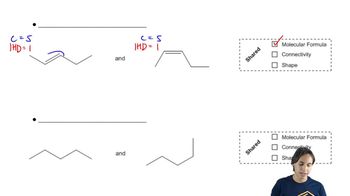
Determining when molecules are stereoisomers.