Ch. 12 - Radicals
Bruice - Organic Chemistry 8th Edition
Bruice8th EditionOrganic ChemistryISBN: 9780135213711당신이 사용하는 게 아니라요?교과서 변경
12장, 문제 39c

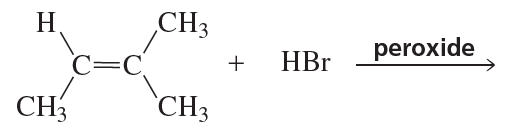
What alkyl halide will be obtained in greatest yield? Ignore stereoisomers.
c. Chemical reaction showing alkene with HBr and peroxide, illustrating anti Markovnikov addition.

검증된 단계별 안내
1
Step 1: Recognize the reaction type. The presence of peroxide indicates that this is a free radical addition of HBr to an alkene, following the anti-Markovnikov rule. This means the bromine atom will add to the less substituted carbon of the double bond.
Step 2: Identify the structure of the alkene. The given alkene is 2-methyl-2-butene, which has a double bond between the second and third carbons.
Step 3: Determine the less substituted carbon in the double bond. In 2-methyl-2-butene, the less substituted carbon is the third carbon, as the second carbon is bonded to three other carbons.
Step 4: Predict the product. The bromine atom will add to the third carbon, and the hydrogen atom will add to the second carbon, resulting in the formation of 3-bromo-2-methylbutane.
Step 5: Confirm the major product. Since the reaction follows the anti-Markovnikov rule and stereoisomers are ignored, the major product will be 3-bromo-2-methylbutane.

비슷한 문제에 대한 검증된 영상 답변:

이 영상 해법은 위 문제에 도움이 된다고 튜터들이 추천한 것입니다.
영상 길이:
4m

주요 개념

질문에 올바르게 답하기 위해 반드시 이해해야 하는 핵심 개념들은 다음과 같습니다.

Anti-Markovnikov Addition

Anti-Markovnikov addition refers to the addition of HX (where X is a halogen) to alkenes in a manner that results in the halogen attaching to the less substituted carbon atom. This is typically facilitated by the presence of peroxides, which promote a radical mechanism, leading to the formation of the less stable radical intermediate and ultimately favoring the less substituted product.
추천 영상:
02:43
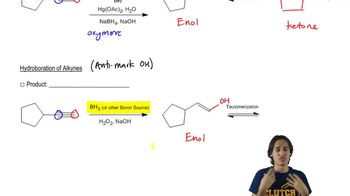
Anti-Markovnikov addition of alcohols to terminal alkynes yields aldehydes

Radical Mechanism

A radical mechanism involves the formation and reaction of free radicals, which are highly reactive species with unpaired electrons. In the context of alkene reactions with HBr in the presence of peroxides, the radical mechanism allows for the anti-Markovnikov addition by generating bromine radicals that add to the alkene, leading to the formation of the product with the bromine on the less substituted carbon.
추천 영상:
03:28
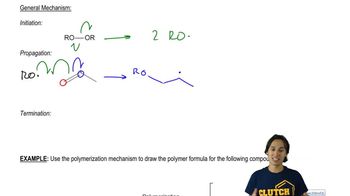
The mechanism of Radical Polymerization.

Alkyl Halides

Alkyl halides are organic compounds derived from alkanes that contain one or more halogen atoms (F, Cl, Br, I) replacing hydrogen atoms. The structure and substitution pattern of the alkyl halide influence its reactivity and stability, which is crucial when determining the yield of products in reactions involving alkenes and halogen acids, especially under radical conditions.
추천 영상:
01:52
How to name alkyl halides