Ch. 12 - Radicals
Bruice - Organic Chemistry 8th Edition
Bruice8th EditionOrganic ChemistryISBN: 9780135213711당신이 사용하는 게 아니라요?교과서 변경
12장, 문제 39f

What alkyl halide will be obtained in greatest yield? Ignore stereoisomers.
f.

검증된 단계별 안내
1
Step 1: Analyze the reaction conditions. The presence of peroxide indicates that the reaction will follow the anti-Markovnikov addition mechanism due to the free radical pathway.
Step 2: Identify the structure of the alkene. The molecule contains a double bond between the CH=CH2 group and the cyclohexane ring. This is the reactive site for the addition of HBr.
Step 3: In the anti-Markovnikov mechanism, the bromine atom (Br) will add to the less substituted carbon of the double bond, while the hydrogen atom (H) will add to the more substituted carbon.
Step 4: Determine the less substituted carbon in the double bond. In this case, the terminal carbon of the CH=CH2 group is less substituted, while the internal carbon connected to the cyclohexane ring is more substituted.
Step 5: Predict the product. The bromine atom will attach to the terminal carbon of the CH=CH2 group, forming an alkyl halide with the bromine on the less substituted carbon. Ignore stereoisomers as instructed.

비슷한 문제에 대한 검증된 영상 답변:

이 영상 해법은 위 문제에 도움이 된다고 튜터들이 추천한 것입니다.
영상 길이:
3m

주요 개념

질문에 올바르게 답하기 위해 반드시 이해해야 하는 핵심 개념들은 다음과 같습니다.

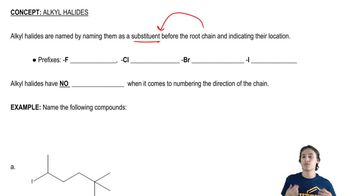
Alkyl Halides

Alkyl halides are organic compounds containing a carbon atom bonded to a halogen atom (F, Cl, Br, I). They are formed through the substitution of hydrogen atoms in alkanes with halogen atoms. The reactivity and stability of alkyl halides depend on the structure of the carbon chain and the nature of the halogen, influencing their formation and yield in reactions.
추천 영상:
01:52
How to name alkyl halides

Markovnikov's Rule

Markovnikov's Rule states that in the addition of HX (where X is a halogen) to an alkene, the hydrogen atom will attach to the carbon with the greater number of hydrogen atoms already attached. This rule helps predict the major product of the reaction, guiding the formation of more stable carbocations and thus influencing the yield of the resulting alkyl halide.
추천 영상:
03:54
The 18 and 16 Electron Rule

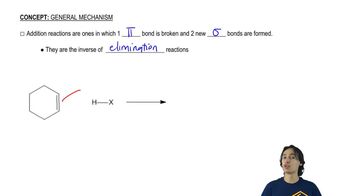
Radical Mechanism in Addition Reactions

In the presence of peroxides, the addition of HBr to alkenes can proceed via a radical mechanism, which differs from the typical ionic mechanism. This process leads to the formation of the less stable radical intermediate, resulting in the anti-Markovnikov product. Understanding this mechanism is crucial for predicting the major alkyl halide product and its yield in the reaction.
추천 영상:
05:39
Features of Addition Mechanisms.