Ch. 12 - Radicals
Bruice - Organic Chemistry 8th Edition
Bruice8th EditionOrganic ChemistryISBN: 9780135213711당신이 사용하는 게 아니라요?교과서 변경
12장, 문제 13

Write the propagation steps for the addition of HBr to 1-methylcyclohexene in the presence of a peroxide

검증된 단계별 안내
1
Identify the reaction mechanism: The presence of a peroxide indicates that the reaction proceeds via a free radical mechanism (anti-Markovnikov addition) rather than the typical electrophilic addition mechanism.
Initiate the reaction: The peroxide decomposes to form two alkoxy radicals (RO•) under heat or light. These radicals are responsible for initiating the free radical chain reaction.
Step 1 of propagation: The alkoxy radical (RO•) abstracts a hydrogen atom from HBr, forming a bromine radical (Br•) and an alcohol (ROH). This step generates the reactive species needed for the next step.
Step 2 of propagation: The bromine radical (Br•) reacts with 1-methylcyclohexene. The Br• adds to the less substituted carbon of the double bond (anti-Markovnikov addition), forming a more stable secondary radical intermediate.
Step 3 of propagation: The secondary radical intermediate reacts with another molecule of HBr, abstracting a hydrogen atom to form the final product (1-bromo-2-methylcyclohexane) and regenerating the bromine radical (Br•), which continues the chain reaction.

비슷한 문제에 대한 검증된 영상 답변:

이 영상 해법은 위 문제에 도움이 된다고 튜터들이 추천한 것입니다.
영상 길이:
5m

주요 개념

질문에 올바르게 답하기 위해 반드시 이해해야 하는 핵심 개념들은 다음과 같습니다.

Electrophilic Addition

Electrophilic addition is a fundamental reaction mechanism in organic chemistry where an electrophile reacts with a nucleophile, typically involving alkenes. In the case of HBr addition to alkenes, the double bond acts as a nucleophile, attacking the electrophilic hydrogen atom of HBr, leading to the formation of a carbocation intermediate.
추천 영상:
09:23
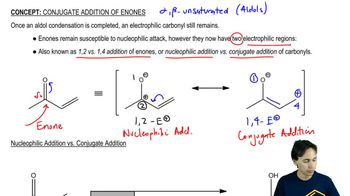
1,2 vs 1,4 Addition

Peroxide Effect (Anti-Markovnikov Addition)

The peroxide effect refers to the phenomenon where the addition of HBr to alkenes in the presence of peroxides leads to anti-Markovnikov addition. This means that the bromine atom attaches to the less substituted carbon of the alkene, contrary to the usual Markovnikov rule, due to the formation of free radicals instead of carbocations during the reaction.
추천 영상:
02:43
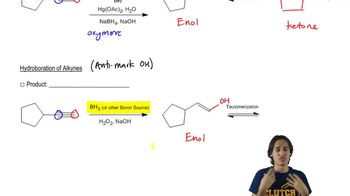
Anti-Markovnikov addition of alcohols to terminal alkynes yields aldehydes

Free Radical Mechanism

The free radical mechanism involves a series of steps including initiation, propagation, and termination, where free radicals are generated and react to form products. In the context of HBr addition to 1-methylcyclohexene with peroxides, the initiation step generates free radicals that facilitate the addition of HBr in a way that favors the formation of the less substituted product.
추천 영상:
03:28
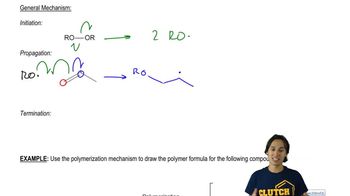
The mechanism of Radical Polymerization.