Ch. 14 - NMR Spectroscopy
Bruice - Organic Chemistry 8th Edition
Bruice8th EditionOrganic ChemistryISBN: 9780135213711당신이 사용하는 게 아니라요?교과서 변경
14장, 문제 41a(7)

Answer the following questions for each compound:
a. How many signals are in its 13C NMR spectrum? b. Which signal is at the lowest frequency?
7.

검증된 단계별 안내
1
Step 1: Analyze the structure of the compound provided. The molecule is a ketone with two carbonyl groups and a linear alkyl chain. Identify all unique carbon environments in the molecule.
Step 2: Determine the number of unique carbon environments. In 13C NMR spectroscopy, each unique carbon environment corresponds to a distinct signal. Look for symmetry and identical groups to reduce the number of signals.
Step 3: Assign the chemical shifts to each carbon environment. Carbonyl carbons (C=O) typically appear at high frequencies (downfield), while alkyl carbons appear at lower frequencies (upfield). Consider the electronic environment and proximity to electronegative groups.
Step 4: Identify the signal at the lowest frequency. The lowest frequency signal corresponds to the carbon in the least deshielded environment, typically a methyl or methylene group far from electronegative groups or π systems.
Step 5: Summarize the findings. State the total number of signals in the 13C NMR spectrum and specify which carbon corresponds to the lowest frequency signal based on its electronic environment.

비슷한 문제에 대한 검증된 영상 답변:

이 영상 해법은 위 문제에 도움이 된다고 튜터들이 추천한 것입니다.
영상 길이:
4m

주요 개념

질문에 올바르게 답하기 위해 반드시 이해해야 하는 핵심 개념들은 다음과 같습니다.

13C NMR Spectroscopy

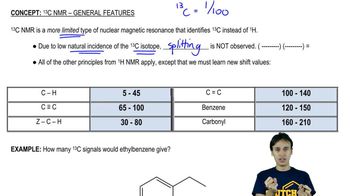
13C NMR (Nuclear Magnetic Resonance) spectroscopy is a technique used to determine the structure of organic compounds by analyzing the carbon atoms in a molecule. Each unique carbon environment in a compound produces a distinct signal in the NMR spectrum. The number of signals corresponds to the number of different carbon environments, allowing chemists to infer structural information about the compound.
추천 영상:
04:00
13C NMR General Features

Chemical Shifts

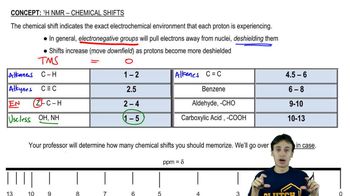
Chemical shifts in NMR spectroscopy refer to the resonance frequency of a nucleus relative to a standard in a magnetic field. In 13C NMR, the chemical shift is influenced by the electronic environment surrounding the carbon atom, including electronegative atoms and hybridization. Signals appear at different frequencies, with lower frequency signals typically indicating more shielded environments, such as those near electron-donating groups.
추천 영상:
11:44
1H NMR Chemical Shifts

Signal Interpretation

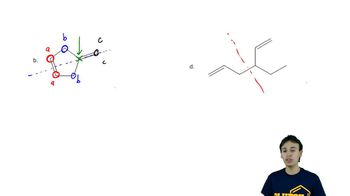
Interpreting signals in an NMR spectrum involves analyzing the number of signals, their positions, and their intensities. Each signal corresponds to a unique carbon environment, and the position of the signal indicates the chemical shift. By understanding the structure of the compound, one can predict which signal will appear at the lowest frequency, often associated with carbonyl groups or other electron-withdrawing functionalities.
추천 영상:
02:02
Identifying Proton Signals