Ch. 14 - NMR Spectroscopy
Bruice - Organic Chemistry 8th Edition
Bruice8th EditionOrganic ChemistryISBN: 9780135213711당신이 사용하는 게 아니라요?교과서 변경
14장, 문제 35

How would the 1H NMR spectra for the four compounds with molecular formula C3H6Br2 differ?

검증된 단계별 안내
1
Identify the possible isomers of the molecular formula C3H6Br2. These include 1,1-dibromopropane, 1,2-dibromopropane, 1,3-dibromopropane, and 2,2-dibromopropane. Each isomer has a unique structure that will influence its 1H NMR spectrum.
Analyze the symmetry and environment of the hydrogen atoms in each isomer. For example, in 1,1-dibromopropane, the two bromine atoms are attached to the same carbon, creating distinct environments for the hydrogens on the other carbons. In contrast, 1,3-dibromopropane has a more symmetrical structure.
Determine the number of unique proton environments for each isomer. For instance, 1,1-dibromopropane will have three distinct proton environments, while 2,2-dibromopropane will have fewer due to its higher symmetry.
Predict the splitting patterns for each unique proton environment based on the number of neighboring hydrogens (n+1 rule). For example, in 1,2-dibromopropane, the hydrogens on the central carbon will experience splitting due to the hydrogens on adjacent carbons.
Consider the chemical shifts of the protons in each isomer. Protons near electronegative bromine atoms will appear downfield (higher δ values) in the spectrum. Use this information to differentiate between the isomers based on their 1H NMR spectra.

비슷한 문제에 대한 검증된 영상 답변:

이 영상 해법은 위 문제에 도움이 된다고 튜터들이 추천한 것입니다.
영상 길이:
10m

주요 개념

질문에 올바르게 답하기 위해 반드시 이해해야 하는 핵심 개념들은 다음과 같습니다.

Nuclear Magnetic Resonance (NMR) Spectroscopy

NMR spectroscopy is a powerful analytical technique used to determine the structure of organic compounds. It relies on the magnetic properties of certain nuclei, such as hydrogen-1 (1H), to provide information about the number of hydrogen atoms, their environment, and the connectivity of atoms within a molecule. The resulting spectra display peaks that correspond to different hydrogen environments, allowing chemists to infer structural details.
추천 영상:
10:06
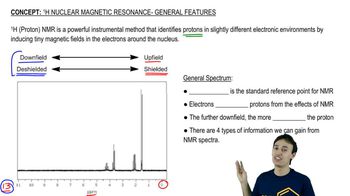
General NMR Features

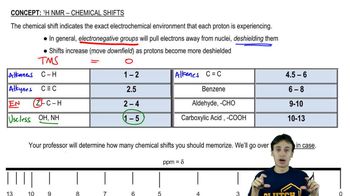
Chemical Shifts

Chemical shifts in NMR spectroscopy refer to the variation in resonance frequency of nuclei due to their electronic environment. In 1H NMR, the position of peaks on the spectrum is measured in parts per million (ppm) and indicates the type of hydrogen atoms present. Different substituents, such as bromine in the case of C3H6Br2 compounds, can cause shifts in the peaks, reflecting the influence of electronegative atoms and the molecular structure on the hydrogen atoms.
추천 영상:
11:44
1H NMR Chemical Shifts

Multiplicity and Coupling

Multiplicity in NMR refers to the splitting of NMR signals into multiple peaks, which occurs due to spin-spin coupling between neighboring hydrogen atoms. The number of peaks (multiplicity) provides insight into the number of adjacent hydrogen atoms (n+1 rule). For the four C3H6Br2 compounds, differences in coupling patterns can arise from variations in molecular structure, leading to distinct multiplicity patterns in their 1H NMR spectra.
추천 영상:
02:54
Sonogashira Coupling Reaction