Ch. 17 - Reactions at the Alpha-Carbon
Bruice - Organic Chemistry 8th Edition
Bruice8th EditionOrganic ChemistryISBN: 9780135213711당신이 사용하는 게 아니라요?교과서 변경
17장, 문제 57

An aldol addition can be catalyzed by acids as well as by bases. Propose a mechanism for the acid-catalyzed aldol addition of propanal.

검증된 단계별 안내
1
Step 1: Begin by protonating the carbonyl oxygen of propanal using an acid catalyst. This increases the electrophilicity of the carbonyl carbon, making it more susceptible to nucleophilic attack. The protonation can be represented as: CH3CHCHO+H+→CH3CHCHOH
Step 2: The alpha hydrogen of propanal becomes more acidic due to the protonation of the carbonyl group. Remove the alpha hydrogen using a weak base (such as water), forming an enol intermediate. The enol structure can be represented as: CH3CHCHOH
Step 3: The enol intermediate acts as a nucleophile and attacks the protonated carbonyl group of another propanal molecule. This step forms a new C-C bond between the alpha carbon of the enol and the carbonyl carbon of the second propanal molecule.
Step 4: After the nucleophilic attack, the intermediate formed undergoes deprotonation to stabilize the molecule. This results in the formation of a beta-hydroxy aldehyde, which is the product of the aldol addition reaction.
Step 5: Finally, regenerate the acid catalyst by transferring a proton from the intermediate to the solvent or another molecule in the reaction mixture. This ensures the catalyst is available for further reactions.

비슷한 문제에 대한 검증된 영상 답변:

이 영상 해법은 위 문제에 도움이 된다고 튜터들이 추천한 것입니다.

주요 개념

질문에 올바르게 답하기 위해 반드시 이해해야 하는 핵심 개념들은 다음과 같습니다.

Aldol Addition

Aldol addition is a reaction between two carbonyl compounds, typically aldehydes or ketones, that results in the formation of a β-hydroxy carbonyl compound. This reaction involves the nucleophilic attack of an enolate ion on another carbonyl carbon, leading to the formation of a new carbon-carbon bond. The aldol product can further undergo dehydration to yield an α,β-unsaturated carbonyl compound.
추천 영상:
09:51
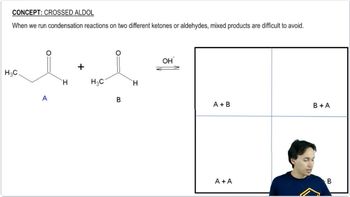
Crossed Aldol

Acid Catalysis

Acid catalysis involves the use of an acid to increase the rate of a chemical reaction. In the context of aldol addition, the acid protonates the carbonyl oxygen, enhancing the electrophilicity of the carbonyl carbon. This makes it more susceptible to nucleophilic attack by the enolate ion, facilitating the formation of the aldol product.
추천 영상:
가이드 코스
2:50
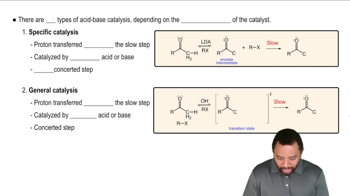
Acid-Base Catalysis Concept 3

Mechanism of Aldol Addition

The mechanism of acid-catalyzed aldol addition begins with the protonation of the carbonyl oxygen, followed by the formation of an enol or enolate ion from another molecule of the aldehyde. The enolate then attacks the protonated carbonyl carbon, leading to the formation of the β-hydroxy carbonyl compound. This mechanism highlights the role of acid in stabilizing intermediates and promoting the reaction pathway.
추천 영상:
09:51
Crossed Aldol