Ch. 17 - Reactions at the Alpha-Carbon
Bruice - Organic Chemistry 8th Edition
Bruice8th EditionOrganic ChemistryISBN: 9780135213711당신이 사용하는 게 아니라요?교과서 변경
17장, 문제 60a,b

Using cyclopentanone as the reactant, show the product of
b. an aldol addition. 
c. an aldol condensation.

검증된 단계별 안내
1
Step 1: Understand the aldol reaction. An aldol addition involves the reaction of an enolate ion (formed from a ketone or aldehyde) with another molecule of ketone or aldehyde to form a β-hydroxy ketone or aldehyde. In an aldol condensation, this β-hydroxy product undergoes dehydration to form an α,β-unsaturated carbonyl compound.
Step 2: Generate the enolate ion from cyclopentanone. Deprotonate the α-hydrogen of cyclopentanone using a base (e.g., hydroxide ion, OH⁻) to form the enolate ion. The enolate ion is resonance-stabilized, with the negative charge delocalized between the oxygen and the α-carbon.
Step 3: Perform the aldol addition. The enolate ion acts as a nucleophile and attacks the carbonyl carbon of another molecule of cyclopentanone. This forms a new C-C bond, resulting in a β-hydroxy ketone intermediate. The structure of this intermediate will have a hydroxyl group (-OH) on the β-carbon relative to the original carbonyl group.
Step 4: For the aldol condensation, dehydrate the β-hydroxy ketone. Under heating or with the presence of a base, the β-hydroxy ketone undergoes elimination of water (dehydration). This forms a double bond between the α and β carbons, resulting in an α,β-unsaturated ketone as the final product.
Step 5: Summarize the products. The aldol addition product is a β-hydroxy ketone, while the aldol condensation product is an α,β-unsaturated ketone. Both reactions start with cyclopentanone as the reactant, and the specific conditions (e.g., base, heat) determine the final product.

비슷한 문제에 대한 검증된 영상 답변:

이 영상 해법은 위 문제에 도움이 된다고 튜터들이 추천한 것입니다.
영상 길이:
2m
도움이 되었나요?

주요 개념

질문에 올바르게 답하기 위해 반드시 이해해야 하는 핵심 개념들은 다음과 같습니다.

Aldol Addition

Aldol addition is a reaction where two carbonyl compounds, typically aldehydes or ketones, react in the presence of a base to form a β-hydroxy carbonyl compound. In this process, one molecule acts as a nucleophile, attacking the carbonyl carbon of another molecule, leading to the formation of a new carbon-carbon bond. This reaction is crucial for building larger, more complex molecules in organic synthesis.
추천 영상:
09:51
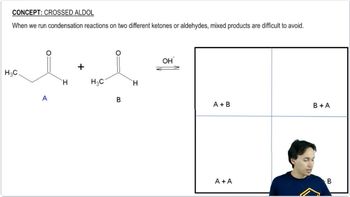
Crossed Aldol

Aldol Condensation

Aldol condensation follows aldol addition and involves the dehydration of the β-hydroxy carbonyl compound formed in the first step. This reaction results in the formation of an α,β-unsaturated carbonyl compound, which is more stable due to resonance. The condensation step typically requires heat and results in the elimination of water, making it an important reaction for creating double bonds in organic compounds.
추천 영상:
09:51
Crossed Aldol

Cyclopentanone

Cyclopentanone is a cyclic ketone with the formula C5H8O, featuring a five-membered ring structure. It serves as a versatile reactant in organic reactions, including aldol reactions, due to its carbonyl group, which can participate in nucleophilic addition. Understanding the structure and reactivity of cyclopentanone is essential for predicting the products of aldol addition and condensation reactions involving this compound.
추천 영상:
00:21
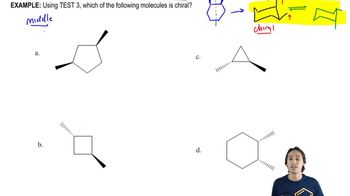
Is the following disubstituted cyclopentane chiral?