Ch. 17 - Reactions at the Alpha-Carbon
Bruice - Organic Chemistry 8th Edition
Bruice8th EditionOrganic ChemistryISBN: 9780135213711당신이 사용하는 게 아니라요?교과서 변경
17장, 문제 17b

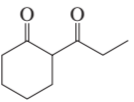
Describe how the following compounds could be prepared from cyclohexanone using an enamine intermediate:
b. Chemical structures of enamine alkylation products derived from cyclohexanone, featuring carbonyl and cyclohexane components.

검증된 단계별 안내
1
Step 1: Understand the role of an enamine intermediate. Enamines are formed by the reaction of a secondary amine with a ketone or aldehyde. In this case, cyclohexanone reacts with a secondary amine (e.g., pyrrolidine) to form the enamine intermediate. This intermediate is nucleophilic at the alpha-carbon, making it useful for further reactions.
Step 2: Identify the target compound and determine the type of reaction needed to achieve it. For example, if the target compound involves alkylation, the enamine intermediate can react with an alkyl halide (R-X) to introduce the desired alkyl group at the alpha-carbon of cyclohexanone.
Step 3: Perform the alkylation reaction. The enamine intermediate reacts with the alkyl halide in an SN2 mechanism, where the nucleophilic alpha-carbon of the enamine attacks the electrophilic carbon of the alkyl halide, displacing the leaving group (X). This step introduces the alkyl group to the cyclohexanone framework.
Step 4: Hydrolyze the enamine back to the ketone. After the alkylation step, the enamine is hydrolyzed under acidic conditions to regenerate the ketone functionality, now bearing the newly introduced substituent at the alpha-carbon.
Step 5: Verify the structure of the final product. Ensure that the desired compound has been synthesized by confirming the position and identity of the substituents introduced during the reaction sequence. This can be done using spectroscopic techniques such as NMR or IR.

비슷한 문제에 대한 검증된 영상 답변:

이 영상 해법은 위 문제에 도움이 된다고 튜터들이 추천한 것입니다.
도움이 되었나요?

주요 개념

질문에 올바르게 답하기 위해 반드시 이해해야 하는 핵심 개념들은 다음과 같습니다.

Enamine Chemistry

Enamines are formed by the reaction of secondary amines with carbonyl compounds, such as ketones or aldehydes. In this context, cyclohexanone reacts with a secondary amine to form an enamine, which serves as a nucleophile in subsequent reactions. This intermediate is crucial for synthesizing various compounds through electrophilic addition or substitution reactions.
추천 영상:
가이드 코스
06:25
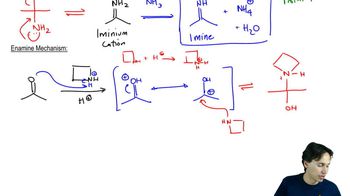
Enamine Mechanism

Nucleophilic Addition

Nucleophilic addition is a fundamental reaction in organic chemistry where a nucleophile attacks an electrophilic carbon atom, typically in a carbonyl group. In the case of enamines, the nucleophilic carbon of the enamine can attack an electrophile, leading to the formation of new carbon-carbon or carbon-heteroatom bonds. Understanding this mechanism is essential for predicting the products formed from cyclohexanone.
추천 영상:
가이드 코스
08:27
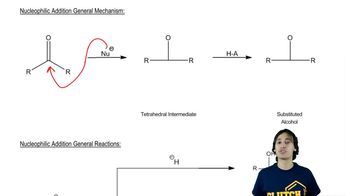
Nucleophilic Addition

Functional Group Transformation

Functional group transformation involves converting one functional group into another through chemical reactions. In the preparation of compounds from cyclohexanone using an enamine, various transformations can occur, such as alkylation or acylation, which modify the functional groups present. Recognizing these transformations is key to understanding how to derive the desired products from the starting material.
추천 영상:
가이드 코스
02:36
Identifying Functional Groups