Ch. 17 - Reactions at the Alpha-Carbon
Bruice - Organic Chemistry 8th Edition
Bruice8th EditionOrganic ChemistryISBN: 9780135213711당신이 사용하는 게 아니라요?교과서 변경
17장, 문제 16a

How could each of the following compounds be prepared from cyclohexanone?
a.

검증된 단계별 안내
1
Step 1: Analyze the target compound. The target compound is a ketone with a butyl group attached to the alpha-carbon of cyclohexanone. This suggests an alkylation reaction at the alpha-carbon of cyclohexanone.
Step 2: Identify the reagent needed for alkylation. To introduce a butyl group, you would use a butyl halide (e.g., 1-bromobutane or 1-chlorobutane) as the alkylating agent.
Step 3: Prepare cyclohexanone for alkylation. Cyclohexanone must first be converted into its enolate form. This can be achieved by treating cyclohexanone with a strong base such as sodium hydride (NaH) or lithium diisopropylamide (LDA). The base deprotonates the alpha-carbon, forming the enolate ion.
Step 4: Perform the alkylation reaction. The enolate ion reacts with the butyl halide in an SN2 mechanism, where the halide is displaced, and the butyl group is attached to the alpha-carbon of cyclohexanone.
Step 5: Purify the product. After the reaction is complete, the mixture can be purified using techniques such as distillation or chromatography to isolate the desired compound.

비슷한 문제에 대한 검증된 영상 답변:

이 영상 해법은 위 문제에 도움이 된다고 튜터들이 추천한 것입니다.
영상 길이:
4m

주요 개념

질문에 올바르게 답하기 위해 반드시 이해해야 하는 핵심 개념들은 다음과 같습니다.

Cyclohexanone Structure and Reactivity

Cyclohexanone is a cyclic ketone with a six-membered carbon ring and a carbonyl group (C=O). Its structure makes it a versatile intermediate in organic synthesis, allowing for various reactions such as nucleophilic addition and oxidation. Understanding its reactivity is crucial for determining how to convert it into other compounds.
추천 영상:
01:17
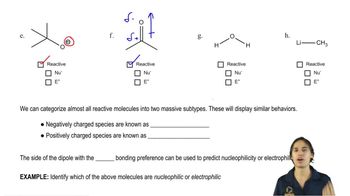
Reactivity of Molecules

Nucleophilic Addition Reactions

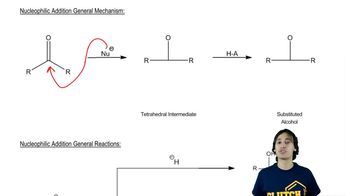
Nucleophilic addition reactions involve the attack of a nucleophile on the electrophilic carbon of a carbonyl group. In the case of cyclohexanone, nucleophiles can add to the carbonyl carbon, leading to the formation of alcohols or other functional groups. This concept is essential for synthesizing derivatives from cyclohexanone.
추천 영상:
08:27
Nucleophilic Addition

Functional Group Transformations

Functional group transformations refer to the chemical reactions that convert one functional group into another. In organic synthesis, these transformations are key to modifying compounds like cyclohexanone into desired products. Familiarity with common reactions, such as reduction, oxidation, and substitution, is necessary for planning the synthesis of target compounds.
추천 영상:
02:36
Identifying Functional Groups