Ch. 21 - Amino Acids, Peptides, and Proteins
Bruice - Organic Chemistry 8th Edition
Bruice8th EditionOrganic ChemistryISBN: 9780135213711당신이 사용하는 게 아니라요?교과서 변경
21장, 문제 57b,c

What aldehydes are formed when the following amino acids are treated with ninhydrin? 
b. leucine 
c. arginine

검증된 단계별 안내
1
Understand the reaction: Ninhydrin reacts with amino acids to produce aldehydes, carbon dioxide, and ammonia. The aldehyde formed depends on the structure of the amino acid's side chain.
For leucine: Identify the structure of leucine. It has an isobutyl side chain (-CH2-CH(CH3)2). When treated with ninhydrin, the amino group is removed, and the side chain is converted into an aldehyde. The resulting aldehyde will have the structure of the side chain minus the terminal carbon.
For arginine: Identify the structure of arginine. It has a guanidino group (-C(NH2)2-NH) attached to a 3-carbon chain. When treated with ninhydrin, the guanidino group is removed, and the aldehyde formed will correspond to the 3-carbon chain.
Write the general reaction mechanism: Ninhydrin reacts with the amino group of the amino acid, forming a Schiff base intermediate. This intermediate undergoes decarboxylation and hydrolysis to yield the aldehyde.
Determine the specific aldehydes: For leucine, the aldehyde will be isobutyraldehyde (CH3-CH2-CHO). For arginine, the aldehyde will be 3-aminopropanal (H2N-CH2-CH2-CHO).

비슷한 문제에 대한 검증된 영상 답변:

이 영상 해법은 위 문제에 도움이 된다고 튜터들이 추천한 것입니다.
영상 길이:
1m

주요 개념

질문에 올바르게 답하기 위해 반드시 이해해야 하는 핵심 개념들은 다음과 같습니다.

Amino Acids

Amino acids are organic compounds that serve as the building blocks of proteins. Each amino acid has a central carbon atom bonded to an amino group, a carboxyl group, a hydrogen atom, and a variable side chain (R group) that determines its unique properties. Understanding the structure and properties of specific amino acids, such as leucine and arginine, is essential for predicting the products formed during chemical reactions.
추천 영상:
09:36
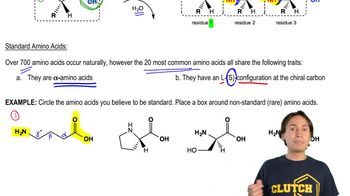
Standard Amino Acids

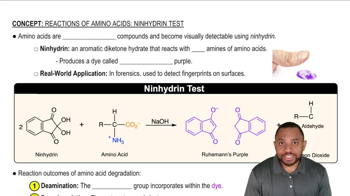
Ninhydrin Reaction

The ninhydrin reaction is a chemical test used to detect amino acids and proteins. When amino acids react with ninhydrin, they undergo a dehydration reaction, resulting in the formation of a colored complex, typically a purple-blue hue. This reaction not only confirms the presence of amino acids but also leads to the formation of aldehydes, which are important for identifying the specific amino acids involved.
추천 영상:
가이드 코스
2:49
Reactions of Amino Acids: Nihydrin Test Concept 1

Aldehyde Formation

Aldehydes are organic compounds characterized by the presence of a carbonyl group (C=O) bonded to at least one hydrogen atom. In the context of the ninhydrin reaction, the amino acids leucine and arginine are converted into their corresponding aldehydes upon treatment with ninhydrin. Recognizing the specific aldehydes formed from these amino acids is crucial for understanding the outcomes of the reaction and the identification of the amino acids.
추천 영상:
01:34
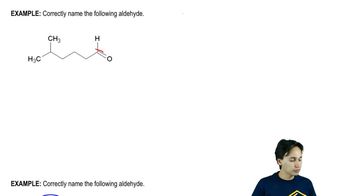
Name the aldehyde