Ch. 28 - Pericyclic Reactions
Bruice - Organic Chemistry 8th Edition
Bruice8th EditionOrganic ChemistryISBN: 9780135213711당신이 사용하는 게 아니라요?교과서 변경
24장, 문제 45

How can this transformation be carried out using only heat or light?

검증된 단계별 안내
1
Analyze the given chemical structures: The starting material is a cis-stilbene derivative, and the product is a trans-stilbene derivative. This transformation involves the isomerization of the double bond from cis to trans configuration.
Understand the mechanism: This isomerization can be achieved using either heat or light. Heat promotes thermal isomerization, while light induces photochemical isomerization. Both methods involve breaking the π-bond temporarily to allow rotation around the double bond.
For thermal isomerization: Apply heat to the molecule. The energy provided by heat can overcome the activation barrier, allowing the molecule to transition from the cis to the trans configuration.
For photochemical isomerization: Expose the molecule to UV light. The light excites the π-electrons of the double bond to a higher energy state, creating a singlet or triplet excited state. This excited state allows free rotation around the double bond, leading to the trans configuration upon relaxation.
Ensure proper conditions: If using heat, maintain a controlled temperature to avoid decomposition. If using light, use a UV lamp with the appropriate wavelength to excite the π-electrons effectively.

비슷한 문제에 대한 검증된 영상 답변:

이 영상 해법은 위 문제에 도움이 된다고 튜터들이 추천한 것입니다.
영상 길이:
10m
도움이 되었나요?

주요 개념

질문에 올바르게 답하기 위해 반드시 이해해야 하는 핵심 개념들은 다음과 같습니다.

Photochemical Reactions

Photochemical reactions are chemical processes that are initiated by the absorption of light. In organic chemistry, these reactions often involve the excitation of electrons, leading to the formation of reactive intermediates. Understanding how light energy can drive transformations is crucial for predicting the outcomes of reactions that rely on light as a catalyst.
추천 영상:
09:36
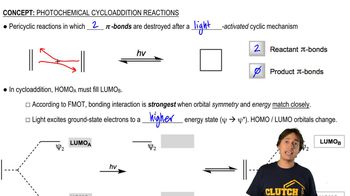
MO Theory of Photochemical Cycloadditions

Thermal Reactions

Thermal reactions are chemical reactions that occur due to the application of heat. Heat can provide the necessary energy to overcome activation barriers, allowing reactants to convert into products. In organic chemistry, recognizing how temperature influences reaction rates and mechanisms is essential for understanding transformations that occur solely through thermal energy.
추천 영상:
06:36
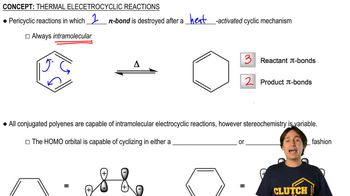
MO Theory of Thermal Electrocyclics

Reaction Mechanisms

Reaction mechanisms describe the step-by-step sequence of elementary reactions that lead to the overall transformation of reactants into products. Understanding the mechanism is vital for predicting how heat or light can facilitate a reaction, as it reveals the intermediates and transition states involved. This knowledge helps chemists design conditions that favor desired pathways in organic transformations.
추천 영상:
02:16
Heck Reaction Mechanism