Ch. 28 - Pericyclic Reactions
Bruice - Organic Chemistry 8th Edition
Bruice8th EditionOrganic ChemistryISBN: 9780135213711당신이 사용하는 게 아니라요?교과서 변경
24장, 문제 46

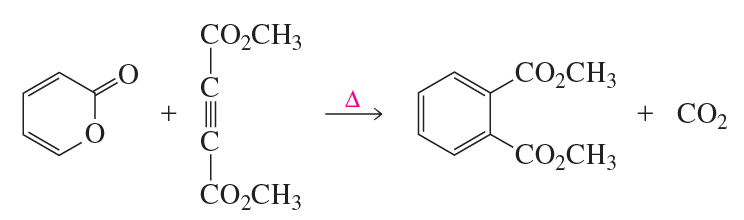
Show the steps involved in the following reaction:
Chemical reaction diagram illustrating the Diels-Alder reaction with reactants, products, and heat symbol.

검증된 단계별 안내
1
Identify the type of reaction: Determine whether the reaction is a substitution, elimination, addition, or another type of organic reaction. This will help guide the mechanism and reagents involved.
Analyze the reactants and reagents: Examine the structure of the starting material and the reagents provided. Consider functional groups, stereochemistry, and any specific conditions (e.g., heat, solvent) that might influence the reaction.
Propose the reaction mechanism: Break down the reaction into individual steps, such as bond breaking and bond forming. Use curved arrows to show the movement of electrons. For example, if it is a nucleophilic substitution, identify the nucleophile, electrophile, and leaving group.
Determine the intermediate(s): If the reaction involves intermediates (e.g., carbocations, carbanions, or radicals), identify their structure and stability. Consider factors like resonance, hyperconjugation, and inductive effects that stabilize or destabilize intermediates.
Predict the product(s): Based on the mechanism and intermediates, deduce the final product(s). Ensure that you account for stereochemistry (e.g., cis/trans, R/S configurations) and regiochemistry (e.g., Markovnikov or anti-Markovnikov addition) if applicable.

비슷한 문제에 대한 검증된 영상 답변:

이 영상 해법은 위 문제에 도움이 된다고 튜터들이 추천한 것입니다.

주요 개념

질문에 올바르게 답하기 위해 반드시 이해해야 하는 핵심 개념들은 다음과 같습니다.

Reaction Mechanism

A reaction mechanism is a step-by-step description of how a chemical reaction occurs at the molecular level. It outlines the sequence of elementary steps, including bond breaking and forming, and the movement of electrons. Understanding the mechanism is crucial for predicting the products and the conditions required for the reaction.
추천 영상:
02:16
Heck Reaction Mechanism

Reagents and Conditions

Reagents are the substances that undergo a chemical change in a reaction, while conditions refer to the environment in which the reaction takes place, such as temperature, pressure, and solvent. Identifying the correct reagents and conditions is essential for successfully carrying out a reaction and achieving the desired products.
추천 영상:
01:52
Reagents

Stereochemistry

Stereochemistry is the study of the spatial arrangement of atoms in molecules and how this affects their chemical behavior. In reactions, the stereochemistry can influence the outcome, including the formation of stereoisomers. Understanding stereochemistry is vital for predicting the properties and reactivity of the products formed in a reaction.
추천 영상:
가이드 코스
1:38
Polymer Stereochemistry Concept 1