Ch. 28 - Pericyclic Reactions
Bruice - Organic Chemistry 8th Edition
Bruice8th EditionOrganic ChemistryISBN: 9780135213711당신이 사용하는 게 아니라요?교과서 변경
24장, 문제 36

Propose a mechanism for the following reaction:
Chemical reaction diagram illustrating a sigmatropic rearrangement mechanism with reactants and products labeled.

검증된 단계별 안내
1
Step 1: Analyze the reactants and products. The reactants include a nitro-substituted pyridine and an ester with two carbonyl groups. The products are a substituted pyridine derivative (A) and a carboxylic acid (B). This suggests a nucleophilic acyl substitution mechanism.
Step 2: Identify the reactive sites. The nitro group on the pyridine ring is electron-withdrawing, making the pyridine ring more electrophilic. The ester contains two carbonyl groups, which are susceptible to nucleophilic attack.
Step 3: Initiate the reaction mechanism. Heat (Δ) facilitates the reaction. The pyridine nitrogen acts as a nucleophile and attacks the carbonyl carbon of the ester, forming a tetrahedral intermediate.
Step 4: Collapse of the tetrahedral intermediate. The intermediate collapses, expelling the ethoxide group (CH₂CH₃O⁻) and forming a new bond between the pyridine nitrogen and the carbonyl carbon. This results in the formation of product A.
Step 5: Formation of product B. The expelled ethoxide group reacts with a proton to form ethanol (CH₃CH₂OH), which subsequently oxidizes to form the carboxylic acid product B.

비슷한 문제에 대한 검증된 영상 답변:

이 영상 해법은 위 문제에 도움이 된다고 튜터들이 추천한 것입니다.
영상 길이:
14m

주요 개념

질문에 올바르게 답하기 위해 반드시 이해해야 하는 핵심 개념들은 다음과 같습니다.

Electrocyclic Reactions

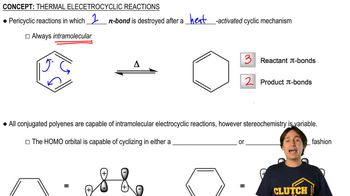
Electrocyclic reactions are a class of pericyclic reactions where a conjugated system undergoes a concerted transformation to form a cyclic compound. These reactions are characterized by the rotation of a sigma bond and the formation or breaking of pi bonds, often influenced by thermal or photochemical conditions. Understanding the stereochemistry and the rules governing these reactions, such as the Woodward-Hoffmann rules, is crucial for predicting the products.
추천 영상:
08:11
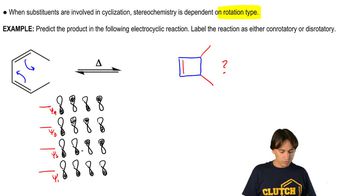
Predicting Electrocyclic Products

Mechanism of Reaction

The mechanism of a reaction describes the step-by-step process by which reactants are converted into products. It includes the identification of intermediates, transition states, and the sequence of bond-breaking and bond-forming events. Proposing a mechanism requires knowledge of reaction conditions, the stability of intermediates, and the energy changes involved, which are essential for understanding how the reaction proceeds.
추천 영상:
02:16
Heck Reaction Mechanism

Thermal Conditions in Organic Reactions

Thermal conditions refer to the influence of heat on the rate and outcome of chemical reactions. In organic chemistry, heating can provide the necessary energy to overcome activation barriers, facilitating reactions such as electrocyclic transformations. The temperature can also affect the selectivity and stereochemistry of the products, making it important to consider when proposing mechanisms for reactions that involve heat.
추천 영상:
06:36
MO Theory of Thermal Electrocyclics