One of the chair conformers of cis-1,3-dimethylcyclohexane is 5.4 kcal/mol less stable than the other. How much steric strain does a 1,3-diaxial interaction between two methyl groups introduce into the conformer?
Ch. 3 - An Introduction to Organic Compounds: Nomenclature, Physical Properties, and Structure
모든 교과서
Bruice 8th Edition
Ch. 3 - An Introduction to Organic Compounds: Nomenclature, Physical Properties, and Structure
문제 87b
Bruice 8th Edition
Ch. 3 - An Introduction to Organic Compounds: Nomenclature, Physical Properties, and Structure
문제 87b3장, 문제 87b
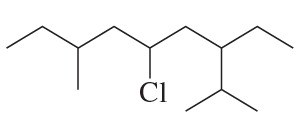
Name the following compounds:
b. 
검증된 단계별 안내1
Identify the longest continuous carbon chain in the compound. This chain will serve as the parent hydrocarbon, and its name will be based on the number of carbon atoms it contains (e.g., methane, ethane, propane, etc.).
Determine the functional group(s) present in the compound. The functional group with the highest priority will influence the suffix of the compound's name (e.g., -ol for alcohols, -al for aldehydes, -one for ketones, etc.).
Number the carbon atoms in the parent chain, starting from the end closest to the highest-priority functional group. This ensures that the functional group receives the lowest possible number.
Identify and name any substituents (side chains or additional groups) attached to the parent chain. Use prefixes such as methyl-, ethyl-, propyl-, etc., to describe these groups, and assign their positions based on the numbering of the parent chain.
Combine the names of the substituents, their positions, and the parent chain name into the final IUPAC name. Ensure that substituents are listed in alphabetical order, and use hyphens to separate numbers from words and commas to separate multiple numbers.

비슷한 문제에 대한 검증된 영상 답변:
이 영상 해법은 위 문제에 도움이 된다고 튜터들이 추천한 것입니다.
영상 길이:
4m주요 개념
질문에 올바르게 답하기 위해 반드시 이해해야 하는 핵심 개념들은 다음과 같습니다.
Nomenclature
Nomenclature in organic chemistry refers to the systematic naming of chemical compounds based on established rules. The International Union of Pure and Applied Chemistry (IUPAC) provides guidelines that help chemists communicate the structure and composition of compounds clearly. Understanding nomenclature is essential for identifying and naming organic molecules accurately.
추천 영상:
가이드 코스
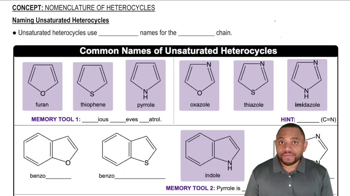
Nomenclature of Heterocycles Concept 2
Functional Groups
Functional groups are specific groups of atoms within molecules that are responsible for the characteristic chemical reactions of those molecules. Common functional groups include hydroxyl (-OH), carboxyl (-COOH), and amino (-NH2) groups. Recognizing functional groups is crucial for naming compounds, as they often dictate the compound's reactivity and properties.
추천 영상:
Identifying Functional Groups
Structural Isomers
Structural isomers are compounds that have the same molecular formula but different structural arrangements of atoms. This can lead to variations in physical and chemical properties. Understanding structural isomerism is important in nomenclature, as different isomers may have distinct names and characteristics, impacting how they are identified and classified.
추천 영상:
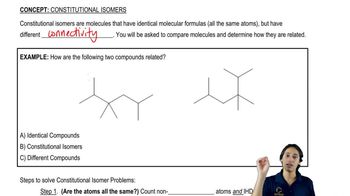
What is a constitutional isomer?
관련 실천
교과서 질문
1417
views
교과서 질문
Name the following compounds:
c.
1086
views
교과서 질문
Explain the following:
a. 1-Hexanol has a higher boiling point than 3-hexanol.
2232
views
교과서 질문
Using the data obtained in Problem 81, calculate the percentage of molecules of trans-1,2-dimethylcyclohexane that will have both methyl groups in equatorial positions.
1241
views
교과서 질문
Bromine is a larger atom than chlorine, but the equilibrium constants in Table 3.9 indicate that a chloro substituent has a greater preference for the equatorial position than does a bromo substituent. Suggest an explanation for this fact.
1632
views
교과서 질문
Using the data obtained in Problem 85, calculate the amount of steric strain in each of the chair conformers of 1,1,3-trimethylcyclohexane. Which conformer predominates at equilibrium?
1356
views